
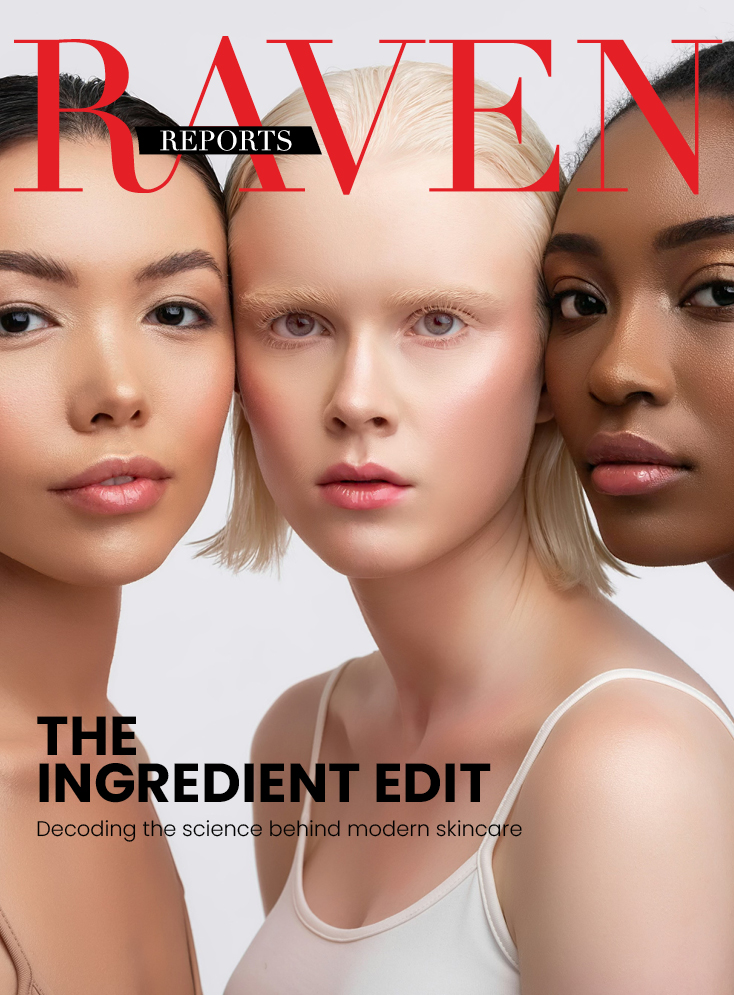
Peptides. Retinoids. Ceramides. Exosomes. PDRN. The language of beauty is becoming increasingly complicated. The Raven Reports’ new series, The Ingredient Edit, is here to make sense of what is actually inside your skincare, what the science says and whether it deserves your money.
By Catalina Tapia
Walk into a beauty store today and buying a moisturiser can feel remarkably like sitting a chemistry exam.
Should you be using peptides? Is retinal better than retinol? What is the difference between Centella and madecassoside? Does your skin barrier need ceramides? What exactly is a postbiotic? And why does that spicule serum feel like hundreds of tiny needles?
Then there are the newer arrivals: exosomes, PDRN and an expanding vocabulary borrowed from biotechnology and regenerative medicine.
Beauty has never given us more information about what is inside our products.
The problem is that more information does not necessarily mean more understanding.
Welcome to The Ingredient Edit
The Ingredient Edit is The Raven Reports’ new evidence-led guide to the ingredients, technologies and terminology shaping beauty around the world.
We are not here to tell you that every trending ingredient belongs in your bathroom.
And we are certainly not going to turn you into a cosmetic chemist.
Instead, each edition will take one ingredient or increasingly complicated beauty term and ask some very simple questions:
What is it?
What is it supposed to do?
What does the science actually say?
What should you look for when reading the label?
And is it worth paying for?
Because there is an important difference between an ingredient having an interesting biological mechanism and a finished skincare product delivering a meaningful result.
A laboratory study is not the same as a clinical trial.
A high percentage is not automatically better.
More ingredients do not necessarily make a better formula.
And a scientific-sounding name on the front of a bottle is not evidence.
Beauty Without Borders
The ingredients in our bathrooms have increasingly global stories.
A botanical with centuries of traditional use may become the hero of a contemporary formulation. A technology developed for medicine may find its way into a cosmetic serum. An ingredient popularised by Korean beauty can appear months later on shelves in London, Sydney, Dubai, Paris or New York.
Understanding where an ingredient comes from matters. But so does understanding what happened to it once it entered the beauty industry.
The Ingredient Edit will investigate established ingredients such as retinoids, vitamin C, ceramides and niacinamide alongside emerging areas including spicules, exosomes, growth factors and DNA-derived skincare technologies.
Along the way, we will speak to scientists, dermatologists, formulators, cosmetic doctors, founders and industry experts from around the world.
Their perspectives will add context. The evidence remains the benchmark.
Where the science is strong, we will tell you.
Where it is promising but preliminary, we will tell you that too.
And where the marketing has travelled considerably further than the research, we will ask why.
First Up: Peptides
We begin with one of skincare’s most crowded categories.
Peptides now appear in everything from affordable moisturisers to serums costing hundreds of dollars, accompanied by claims about collagen, firmness, wrinkles and even comparisons with injectable treatments.
But there are many different peptides. They do not all perform the same function, and more peptides do not automatically make a better product.
So which names should you actually recognise when you turn the bottle around?
That’s where The Ingredient Edit begins.
Next: Peptides Are Everywhere. But What Do They Actually Do?
Because the goal isn’t to know every ingredient in your bathroom.
It’s to know enough to understand what you’re actually being sold.
By Catalina Tapia