
Peptides appear in everything from affordable moisturisers to expensive serums, usually accompanied by impressive claims about collagen, firmness and wrinkles. But what exactly are they, which ones should you look for, and does your skin actually need them? Here is what you need to know before your next beauty purchase.
By Catalina Tapia
Walk into almost any beauty store and you will find the word peptide.
Peptide serum. Multi-peptide cream. Copper peptides. Peptide eye treatment. Perhaps even a formula promising results that sound suspiciously similar to an injectable treatment.
It sounds very scientific. The reality is simpler.
Peptides are tiny chains of amino acids, and amino acids are the building blocks our bodies use to make proteins, including collagen and elastin.
Think of amino acids as individual Lego bricks. A few joined together make a peptide. Join many more together in increasingly complex structures and you can make proteins.
Why does that matter for your skin?
Because certain peptides can act rather like messages. Different peptides are designed to send or influence different signals within the skin.
Not all peptides do the same thing.
To help make sense of an increasingly crowded category, The Raven Reports spoke to Maria Enna-Cocciolone, Founder and CEO of INSKIN COSMEDICS, who has worked in the professional beauty industry for four decades.
“A peptide is a short chain of amino acids, which are like tiny messengers that help tell your skin what to do,” she says. “Depending on the type of peptide, they can encourage the skin to support collagen, improve firmness, strengthen the skin barrier and help reduce the appearance of fine lines.”
So, what can peptides actually do?
A 2025 scientific review identified 102 commercially available cosmetic peptides.¹ You certainly do not need to memorise them all.
The easiest way to understand peptides is by what they are designed to do. Scientists commonly group cosmetic peptides into four main functional families:²
Signal peptides are generally associated with fine lines, texture and firmness.
Carrier peptides transport substances such as copper that are involved in skin processes.
Neurotransmitter-inhibiting peptides are designed to target pathways associated with expression lines.
Enzyme-inhibiting peptides are designed to limit enzymes involved in breaking down structural components such as collagen.
Newer peptides are also being developed for concerns including pigmentation, antioxidant defence, microbiome support and other aspects of skin function. The evidence varies considerably between individual peptides.
The important thing is to match the peptide to the concern, rather than buying something simply because the word appears on the bottle.
A Simple Peptide Guide by Life Stage
Age should never dictate your skincare routine, but our skin does change throughout life. This provides a useful starting point when navigating the increasingly crowded peptide category.
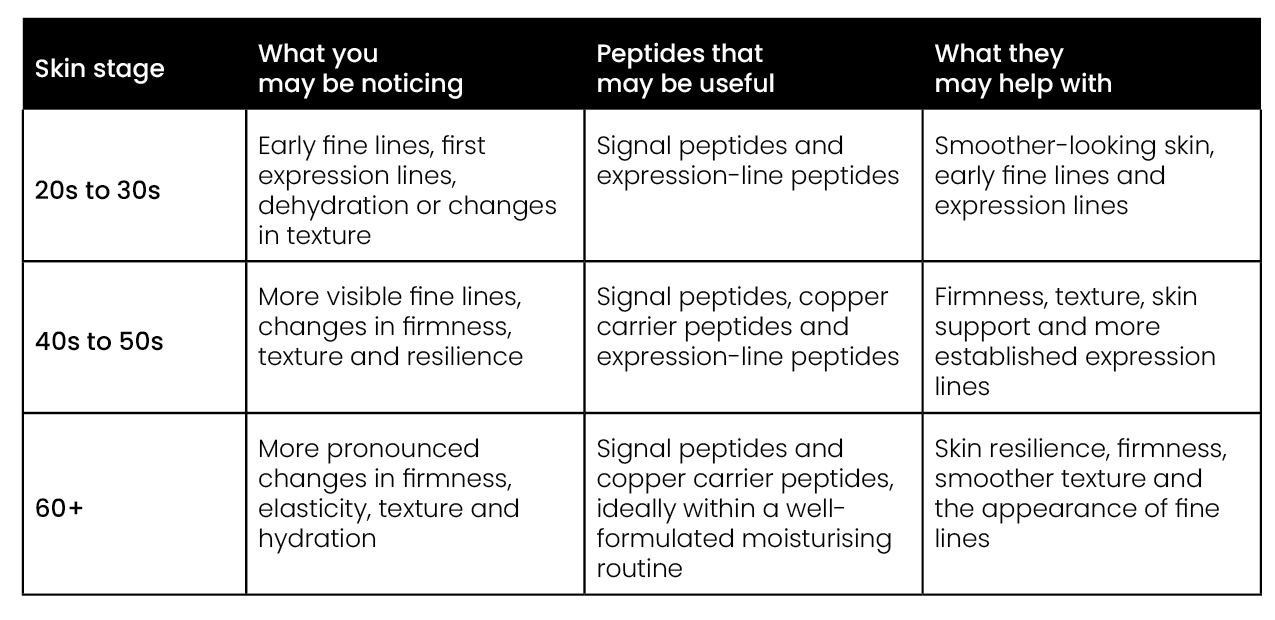
Remember: these age groups are a shopping guide, not a prescription.
Maria takes the same concern-led approach. “This is where birthdays don’t matter and one should be guided by skin needs! As the skin changes different peptides will offer varying skin support. Peptides can be particularly helpful in supporting changes in collagen, firmness, elasticity, hydration and the appearance of lines and wrinkles, but ultimately skin concerns and skin health should guide the choice,” she says.
If you are in your twenties or early thirties with no particular concern, there is no reason to feel that peptides are compulsory. Daily sunscreen, an appropriate moisturiser and treating genuine skin concerns remain more important than adding another serum simply because it is fashionable.
The Peptide Names Worth Knowing
This is where skincare labels become confusing. Instead of trying to remember every peptide in existence, save this table. These are some of the names you may encounter when comparing products.
So what should you actually look for?
“It truly depends on the skin function, the action you are looking to support,” says Maria.
For consumers wanting actual names to recognise, Maria points to MATRIXYL™ Synthe’6™, SNAP-8® and Munapsys™ for supporting skin structure and targeting the appearance of expression lines. She also highlights Trylagen™ for collagen support, and V8 Peptide Complex®, used in her own formulations, for supporting skin integrity and visible signs of ageing.
The lesson is simple: don’t just look for peptides on the front of the bottle. Look at which peptides are actually in the formula and whether their intended function matches what you want to address.
The Raven Peptide Cheat Sheet
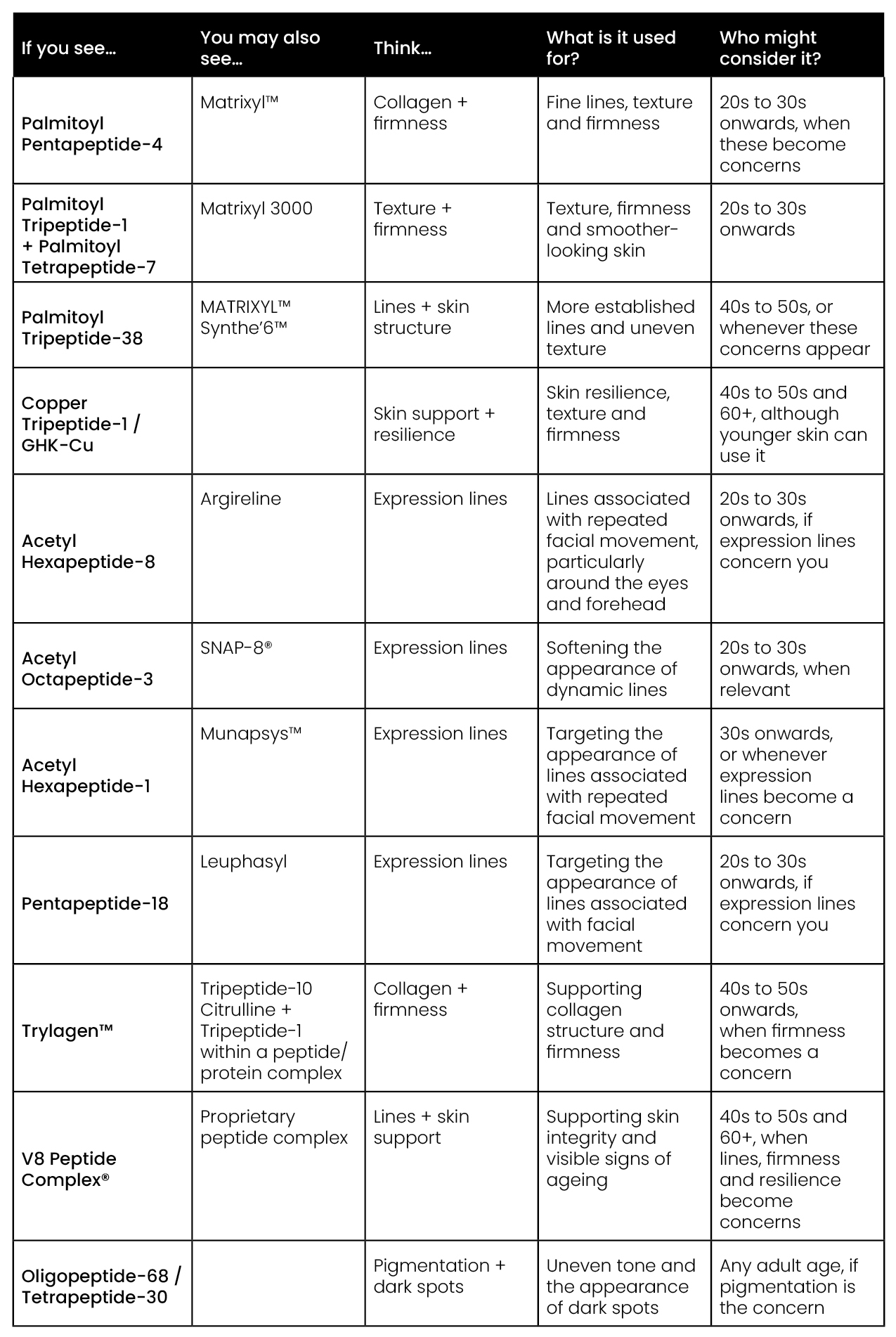
You do not need a product containing every peptide on this list.
Maria is equally sceptical of peptide counting.
“Important to highlight, more peptides do not necessarily mean better skincare or skin results! The magic here is all in the formulation intelligence, the choice of peptides used, the doses of the active used, stability, delivery system and targeted actions are what’s more important than what’s on the label.”
Signal Peptides
Think: fine lines and firmness.
Signal peptides are designed to influence messages associated with components of the skin’s supporting structure, including collagen.
One of the best known is Palmitoyl Pentapeptide-4, commonly associated with the Matrixyl name. Palmitoyl Tripeptide-1 and Palmitoyl Tetrapeptide-7 are often paired as Matrixyl 3000, while Palmitoyl Tripeptide-38 is commonly marketed as MATRIXYL™ Synthe’6™.
Palmitoyl Pentapeptide-4 has some controlled human research behind it.³ In one study involving 93 women aged 35 to 55, a moisturiser containing the peptide produced improvements in the appearance of fine lines and wrinkles compared with the control moisturiser.
That does not mean every product containing it will produce identical results. Formulation still matters.
If you are shopping for a peptide product because fine lines, texture or firmness concern you, signal peptides are a sensible place to start.
Copper Peptides
Think: skin support and resilience.
The best known is GHK-Cu, which you will usually find on an ingredient list as Copper Tripeptide-1. It is called a carrier peptide because it binds to copper.
Copper peptides have been studied in relation to processes including tissue repair and the skin’s supporting structure, which makes them scientifically interesting for skin resilience and texture.
The science surrounding GHK-Cu is interesting, but the evidence showing exactly what a particular topical copper peptide serum will do to your skin is less extensive than some marketing suggests.⁴
If you are concerned with changes in texture, resilience and firmness, copper peptides are worth understanding. They are not necessarily better than other peptides. They are simply designed to do something different.
Expression-Line Peptides
Think: forehead lines and crow’s feet.
One name you may increasingly encounter is Acetyl Hexapeptide-8, commonly known as Argireline. Acetyl Octapeptide-3, known as SNAP-8®, and Pentapeptide-18, also known as Leuphasyl, sit within the same broad expression-line conversation.
These peptides are designed to influence pathways associated with facial movement. Because repeated expressions contribute to lines, they are commonly used in products targeting crow’s feet and forehead lines.
There is some encouraging clinical research, but there is one claim you should treat with considerable scepticism:⁵
“Botox in a bottle.”
IT’S NOT!
Maria agrees that the comparison goes too far. “‘Botox in a bottle’ is a catchy marketing phrase, yet not accurate in scientific comparison. Peptides such as Argireline can support softening of expression lines and fine wrinkles overtime, however, don’t work the same way as injectables that go into the muscle. Injectables give dramatic results, topical peptides with accumulative application refine and smooth the skin.”
In other words, a topical peptide serum and an injectable treatment are not interchangeable.
What About Peptides for Pigmentation?
Some peptides, including Oligopeptide-68 and Tetrapeptide-30, are used in formulas designed to target pathways involved in uneven tone and pigmentation.⁶
This is an interesting area, but the evidence varies significantly between individual peptides and is less established than for many conventional pigmentation ingredients. Some human research also involves multi-ingredient formulas, which makes it difficult to attribute the result to the peptide alone.
If pigmentation is your primary concern, look for evidence relating to the finished product rather than assuming the word peptide makes it the best place to begin.
Can Peptides Replace Retinol?
Not really, because they are not doing exactly the same job.
Retinoids have a much longer and stronger clinical history, particularly prescription tretinoin. Peptides tend to be gentler and may appeal to people who struggle with stronger active ingredients.
You do not necessarily have to choose between them. Compatibility depends on the individual ingredients and finished formulation, so blanket rules about never combining peptides with retinoids, vitamin C or acids are not especially useful.
We will untangle retinol, retinal and retinoids in the next edition of The Ingredient Edit.
The Raven Shopping Test
Before buying a peptide product, ask five questions.
1. Which peptide is actually in it?
Look beyond “multi-peptide technology” on the front of the bottle. Check the ingredient list. If you see Palmitoyl Pentapeptide-4, think fine lines and firmness. If you see Copper Tripeptide-1, think skin support and resilience. If you see Acetyl Hexapeptide-8, think expression lines.
2. What am I buying it to do?
Fine lines? Firmness? Expression lines? Pigmentation? If you cannot answer that question, you probably do not need the product.
3. Does the claim sound realistic?
“Helps improve the appearance of fine lines” is reasonable. “Works like Botox” deserves considerably more scepticism.
4. Has the actual product been tested?
Evidence about an individual peptide is useful. Evidence showing that the finished serum you are buying works is even better. A brand should ideally be able to explain what was tested, how many people participated, how long the study lasted and what actually improved.
5. Am I paying for performance or prestige?
When it comes to price, Maria’s advice is similarly formulation-led.
“Price is not indicative of quality ingredients, formulations, active doses and sophisticated formulations that can offer true results. A higher price can be justified when there is strong science behind the specific peptides, meaningful concentrations, good stability, sophisticated delivery systems and evidence that the finished product performs as claimed.”
In other words, an expensive peptide serum is not automatically superior to an affordable one.
If You Remember Nothing Else
Fine lines and firmness? Look for Palmitoyl Pentapeptide-4, Palmitoyl Tripeptide-1 or Palmitoyl Tripeptide-38.
Skin resilience and support? Look for Copper Tripeptide-1 (GHK-Cu).
Crow’s feet and expression lines? Look for Acetyl Hexapeptide-8 (Argireline), Acetyl Octapeptide-3 (SNAP-8®) or Pentapeptide-18 (Leuphasyl).
Pigmentation? Oligopeptide-68 and Tetrapeptide-30 are examples, but look for evidence supporting the specific ingredient and finished formula.
“Multi-peptide complex”? Turn the bottle around. The number of peptides matters less than which peptides are actually in the formula and what they are intended to do.
What Does the Science Actually Say?
There is genuine science behind peptides, but the evidence varies considerably.
Some individual peptides have controlled human studies supporting improvements in visible concerns such as fine lines and texture.⁷ Others have stronger laboratory or manufacturer data than human clinical evidence.
One of the biggest challenges with topical peptides is getting them to the right place in the skin.² Peptides can struggle to cross the skin barrier and may also degrade.
For Maria, this is why the ingredient list is only the beginning.
“An impressive ingredient list, or peptide callout doesn’t necessarily make an impressive formulation. Delivery is everything, but where they go is even more important. Some peptides are created to act within or near the upper layers of the skin and others are designed to go deeper. Scientifically the key is ‘getting the peptides to their intended site of action to trigger the actions required for transformative skincare’.”
This is also why the position of a peptide on an ingredient list cannot reliably tell you whether a product contains an effective amount. Nor does a serum necessarily deliver peptides better than a cream simply because it feels lighter.
The serum is more than its star ingredient.
The Raven Verdict
After four decades in professional beauty, Maria considers peptides to have moved beyond a passing trend.
“Peptides aren’t new, we have used peptides in our brands since conception. What’s new is the global interest in them and the innovation around them,” she says.
Her test is straightforward: “I need the right peptide, in the right (sophisticated) formulation, at the right level (active dose), with evidence that supports the finished product actually performs.”
But do not buy something simply because PEPTIDES appears in large letters on the bottle.
When you are standing in front of a 1,000 AED peptide serum and a 150 AED alternative, do not automatically assume the expensive bottle wins.
Turn them around. Read the ingredients. Work out which peptides you are actually buying and what they are intended to do.
Then ask whether the brand has enough evidence to justify the promise, and the price.
The goal is not to turn every beauty shopper into a cosmetic chemist. It is simply to know enough that the next time the word peptide appears on a bottle, you understand what you are actually being sold.
The Expert: Maria Enna-Cocciolone
Maria Enna-Cocciolone is the Founder and CEO of INSKIN COSMEDICS, the Australian professional beauty company she established in 2007. With 40 years of experience in the professional beauty industry, her career has spanned aesthetics, sales, education, management, business ownership and skincare brand development.
Through INSKIN COSMEDICS, Maria has created three professional skincare brands: O COSMEDICS, GINGER&ME and INSKIN.CO. She is also a Board member of the Aesthetic Beauty Industry Council, and remains closely involved in the development and direction of the INSKIN COSMEDICS portfolio as the company expands internationally.
Her philosophy is that the brands within her portfolio should make both “good business and good skin sense”, with an emphasis on professional education, considered formulation and supporting skin professionals and their clients.
Expert Disclosure: Maria’s comments in this article reflect her professional beauty-industry perspective. Independent scientific literature remains the basis for The Raven Reports’ assessment of peptide efficacy.
Explore O COSMEDICS or follow O COSMEDICS on Instagram.
THE INGREDIENT EDIT
Next: Retinol, Retinal and Retinoids: What’s the Difference and Which One Should You Actually Buy?
Fact-Check Note
The simplified peptide categories reflect published cosmetic peptide literature. A 2025 review identified 102 commercially available cosmetic peptides and found that evidence varies considerably across the category, with much research still based on laboratory or ex-vivo models.
The life-stage groups are editorial shopping guidance, not clinical recommendations. Skin concerns, genetics, sun exposure, hormonal changes and individual tolerance matter more than chronological age.
Evidence concerning one peptide or finished formula should not be extrapolated to every peptide product.
Interview fact-check: Enna-Cocciolone’s statement that injectables used alongside topical peptides “have been known to last longer” has not been included because the supplied interview does not provide clinical evidence for that claim.
Her broader statement that peptides can “strengthen the skin barrier” is retained only as her attributed professional view and should not be generalised to all peptides.
References
- van Walraven N, FitzGerald RJ, Danneel H-J, Amigo-Benavent M. Bioactive peptides in cosmetic formulations: Review of current in vitro and ex vivo evidence. Peptides. 2025;193:171440. doi:10.1016/j.peptides.2025.171440.
- Robinson LR, Fitzgerald NC, Doughty DG, Dawes NC, Berge CA, Bissett DL. Topical palmitoyl pentapeptide provides improvement in photoaged human facial skin. International Journal of Cosmetic Science. 2005;27(3):155-160. doi:10.1111/j.1467-2494.2005.00261.x.
- Mortazavi SM, Mohammadi Vadoud SA, Moghimi HR. Topically applied GHK as an anti-wrinkle peptide: Advantages, problems and prospective. BioImpacts. 2025. PMID: 39963574.
- Aruan RR, Hutabarat H, Widodo AA, Firdiyono MTC, Wirawanty C, Fransiska L. Double-blind, randomized trial on the effectiveness of acetylhexapeptide-3 cream and palmitoyl pentapeptide-4 cream for crow’s feet. Journal of Clinical and Aesthetic Dermatology. 2023;16(2):37-43. PMID: 36909866.
- Pratchyapurit W. Combined use of two formulations containing diacetyl boldine, TGF-β1 biomimetic oligopeptide-68 with other hypopigmenting/exfoliating agents and sunscreen provides effective and convenient treatment for facial melasma. Journal of Cosmetic Dermatology. 2016;15(2):131-144. doi:10.1111/jocd.12201.
- Zhu M, He X, Zhu Z, et al. The effect of a serum containing acetyl hexapeptide-8, dipeptide diaminobutyroyl benzylamide diacetate and gluconolactone on skin biomarkers, wrinkles and skin texture: Ex vivo and clinical studies. International Journal of Cosmetic Science. 2026. doi:10.1111/ics.70087.
- Nukaly HY, Halawani IR, Irtaza HM, et al. Oral and topical peptides for skin aging: Systematic review and meta-analysis of randomized controlled trials. Frontiers in Medicine. 2026;13:1618306. doi:10.3389/fmed.2026.1618306.