

Through The Eyes of a New Himalayan Vision
Photography by Yuliya Drazdovich
Fashion: Druk Lokpa
Cover Stars: Egith Van Dinther & Tshering Zam

There are places that invite admiration.
And then there are places that alter perception.
Bhutan—the Last Shangri-La—belongs to the latter.
Suspended between mythology and modernity, this Himalayan kingdom remains one of the world’s rarest luxuries. Not because of what it possesses, but because of what it has chosen to preserve. Here, silence carries value. Craft remains sacred. Beauty is neither manufactured nor marketed—it simply exists, embedded within mountain passes, fortress monasteries, and generations of living tradition.
For our cover story, Druk Lokpa presents a contemporary vision rooted in cultural memory yet designed for the present moment. The collection moves effortlessly between heritage and innovation, translating centuries of artistry into silhouettes that feel distinctly global while remaining unmistakably Bhutanese.

Photographed on location by Yuliya Drazdovich, the story brings together two compelling women: acclaimed Bhutanese actress Tshering Zam and international model Egith Van Dinther. Together they embody the duality at the heart of this mountain kingdom—grounded yet daring, ancestral yet forward-looking.
Against dramatic peaks, sacred architecture, and windswept valleys, they become extensions of the landscape itself. This is the Dragon Kingdom through the senses.

PREMONITION
Color speaks first.
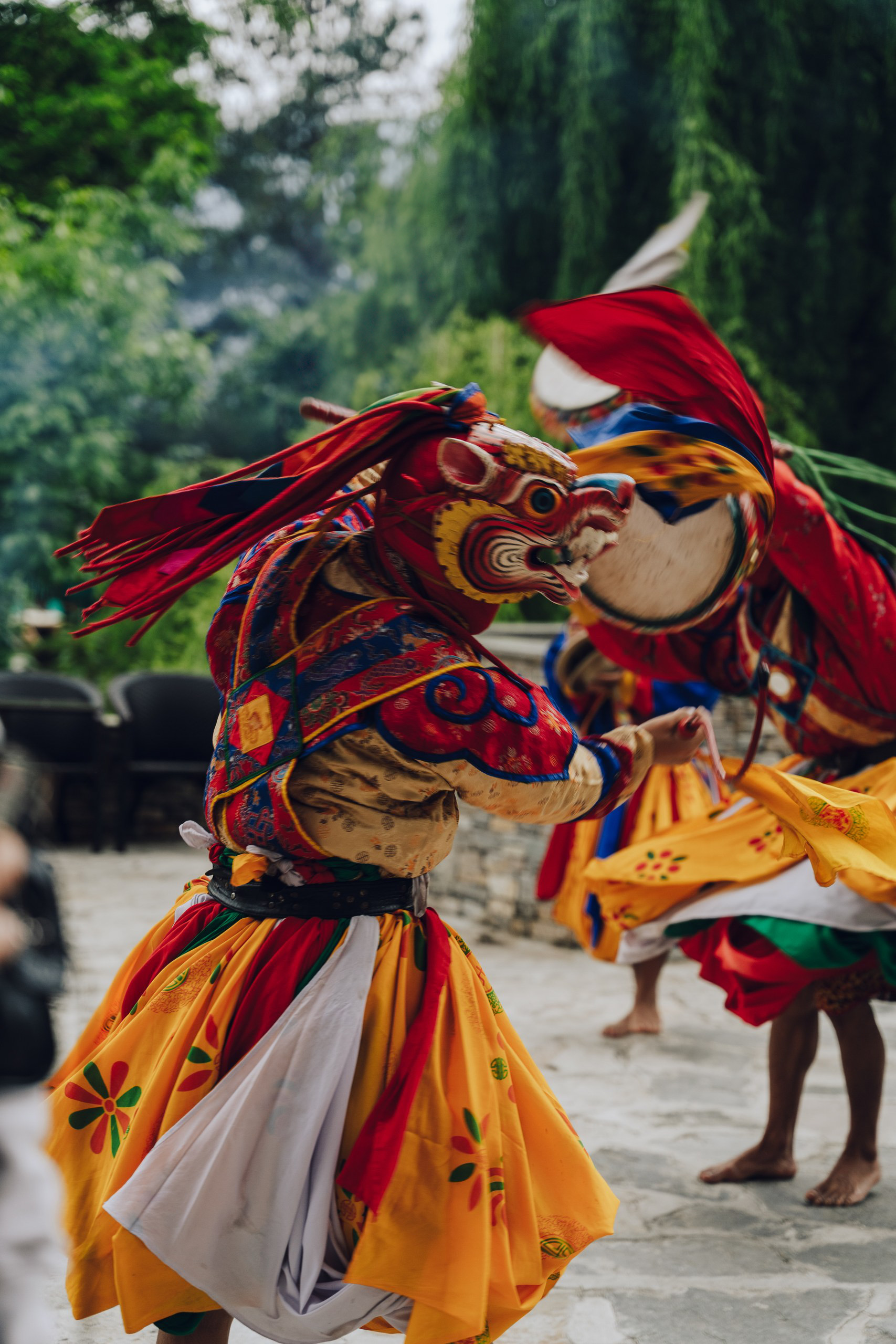
Crimson-robed monks move through fortress monasteries shaped by centuries of devotion. Their presence is both spiritual and architectural—guardians of a living tradition that continues to shape the rhythm of daily life. Rising before dawn, studying sacred texts, preserving rituals passed through generations, they embody a continuity increasingly rare in the contemporary world.

Prayer flags fracture the sky in flashes of blue, green, yellow, red, and white. Ancient dzongs rise from the landscape with cinematic scale, while snow-covered summits hover above the clouds like silent guardians.

Yet devotion in the Dragon Kingdom extends far beyond monastery walls.
Art is everywhere.
Sacred narratives unfold across temple interiors in layers of extraordinary detail. Guardian deities, celestial beings, lotus motifs, and intricate mandalas cover columns, ceilings, and murals painted entirely by hand according to traditions preserved for centuries. Even village streets and urban storefronts carry traces of this visual language, where painted facades transform everyday architecture into expressions of cultural identity.

For the creative vision behind these collections, such contrasts become design language.
The saturated reds.
The mineral whites.
The impossible blues of Himalayan altitude.
The saffrons, golds, and jewel tones of sacred iconography.
Every horizon becomes a palette.
Every journey becomes a study in color.

LISTEN
Luxury is often defined by what surrounds us.
Here, it is defined by what remains absent.
Temple bells.
Ceremonial horns.
Distant chants carried across valleys.
Wind threading through pine forests.
Footsteps crossing stone courtyards polished by centuries of passage.
The low murmur of prayer wheels turning.
The rhythmic cadence of monks reciting ancient texts.

And then comes something increasingly scarce in the modern world:
Silence.
Not emptiness.
Presence.
Perhaps the ultimate luxury.
INVITATION
The Thunder Dragon Kingdom possesses an atmosphere all its own. Juniper smoke drifts from sacred fires. Butter lamps flicker within monastery walls. Mountain air arrives crisp and elemental, carrying traces of pine, stone, earth, and rain.
It is the scent of altitude.
Of ritual.
Of a culture whose spiritual foundations remain deeply intact.
In temple courtyards and mountain passes alike, the boundary between the physical and the sacred feels remarkably thin.
Long after departure, it lingers.

SAVOR
This Himalayan realm reveals itself through flavor. Heat and comfort exist in elegant tension.
Celebrated chillies command attention, while nutty red rice, artisanal cheeses, wild mushrooms, and seasonal produce anchor every meal in place and tradition. Recipes passed through generations carry stories of family, resilience, and cultural continuity. Nothing feels hurried.

Nothing feels performative.
Every table becomes another point of connection.
Every meal becomes an expression of landscape, season, and memory.
TEXTURE
At the heart of this extraordinary landscape lies craftsmanship.

Across the kingdom, hands move patiently over traditional looms, transforming thread into textiles that carry centuries of knowledge. Silk, cotton, yak wool, yak hair, and nettle fiber are woven into intricate compositions where technique becomes storytelling.
Some of the country’s most celebrated weaving traditions originate in Khoma, the legendary village renowned for exceptional silk craftsmanship. Across Lhuentse, widely regarded as Bhutan’s textile heartland, weaving remains both cultural inheritance and living art form. In Bumthang, wool and yak-wool textiles reflect the character of the highlands, while workshops and markets throughout Thimphu continue to connect heritage craftsmanship with contemporary audiences.

The same dedication appears throughout Bhutan’s sacred arts.
Master painters spend years learning the precise proportions, symbolism, and techniques required to create traditional religious works. Murals, thangkas, carved woodwork, painted ornamentation, and gilded sculptures are not merely decorative—they are vessels of philosophy, history, and collective memory.
Elsewhere, timber is carved with remarkable precision. Metalwork blurs the boundary between function and art. Architecture itself becomes a canvas, every beam, cornice, and doorway carrying the mark of a human hand.

For the house behind these creations, this tactile relationship with making remains fundamental.
Fashion begins with touch.
Texture becomes emotion.
Material becomes memory.
FEEL
The true power of the Thunder Dragon’s realm cannot be photographed.
It can only be felt.
In an age defined by acceleration, this sovereign sanctuary remains deliberate. While much of luxury grows louder, it offers something increasingly rare: Authenticity.

Preservation over reinvention.
Meaning over spectacle.
Soul over noise.

It is this philosophy that informs the vision of Druk Lokpa—a label shaped by cultural pride yet conceived for an international audience.

Here, Tshering Zam and Egith Van Dinther do more than wear Bhutan’s fashion.
They embody a new chapter.
Confident.
Creative.
Uncompromising.

Women who understand that modernity does not require the abandonment of heritage, and that the future becomes most compelling when it remains connected to its roots. A kingdom above the clouds moving forward without severing its connection to the past. A culture whose greatest strength lies not in reinvention, but in continuity. Perhaps that is the greatest luxury of all.
By: Lucas Raven

magical trip