
Where the Imperial Palace is your view, a duck is your destiny, and the bar upstairs tells the story of an entire country in cocktails.
By Lucas Raven, Editor-in-Chief
Tokyo humbles even the most seasoned traveler, and I am not easily impressed. So when I tell you that this hotel made me see the city differently, understand that it is not a sentence I hand out lightly.

It begins with the address. The property sits at the meeting point of Marunouchi, Yurakucho and Hibiya, facing the moat and the Imperial Palace gardens on one side and the green hush of Hibiya Park on the other. Ginza is a stroll away. Tokyo Station is close enough to feel like a rumor. And the hotel connects straight to Hibiya Station, which in this city is less a convenience than a superpower. You step out of your suite and the whole capital is, quite simply, within reach.
The Lantern
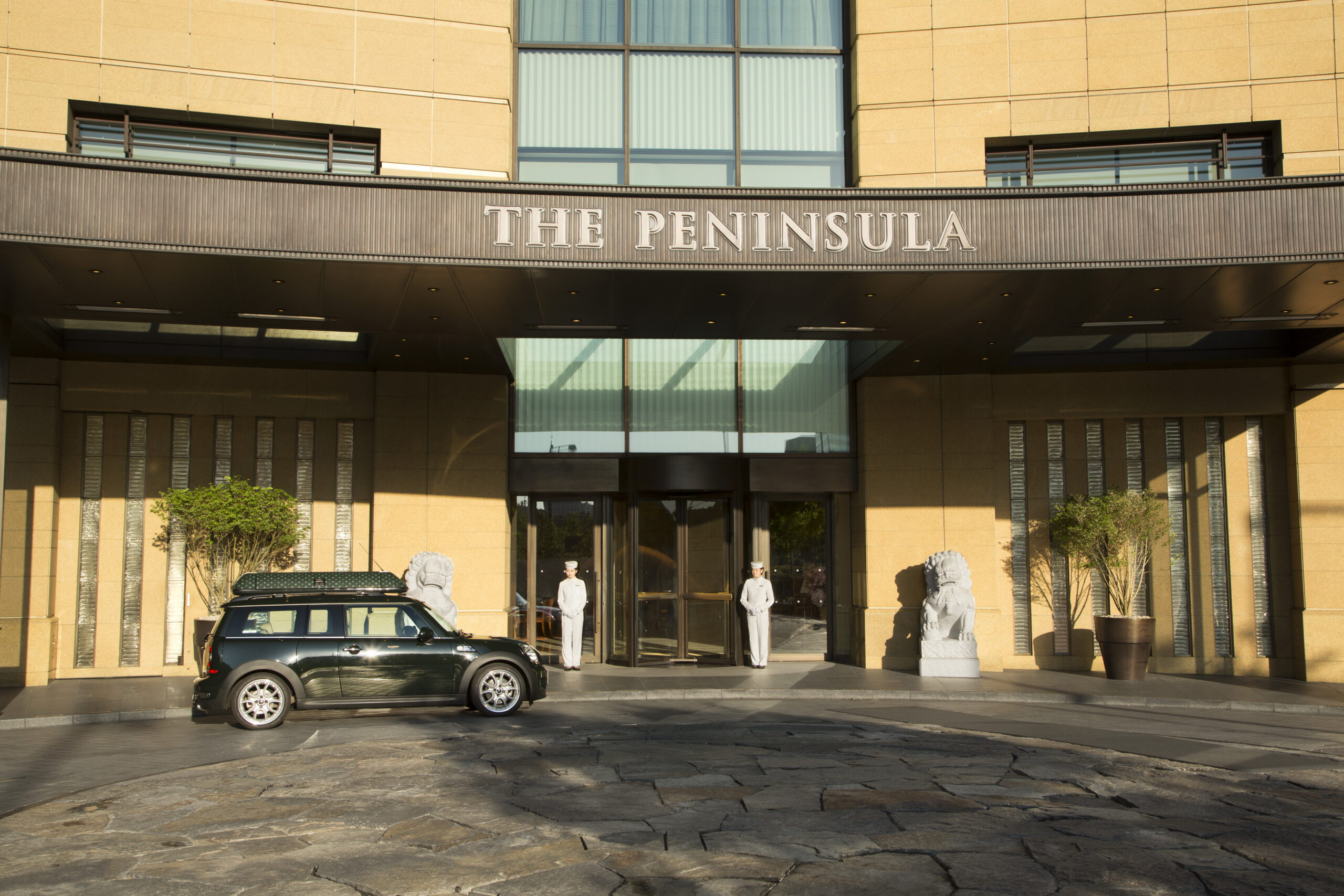
The building is a quiet showstopper. Architect Kazukiyo Sato imagined a freestanding tower as a traditional Japanese lantern, twenty-four stories of pale granite and bronze that glow at the edge of the moat when dusk settles. It is a rarity in a city of crowded skylines: a hotel that stands alone, with room to breathe, as if even the architecture understood the assignment of luxury.

Inside, the interiors by Yukio Hashimoto, an alumnus of the Super Potato school, trade cold minimalism for something warmer and far more seductive. Earth tones, wood, lacquer, marble and stone. Ceilings of hand-woven cedar. Deep reds and bronzes against a calm, neutral palette. It feels less like a hotel and more like the residence of someone with impeccable taste and an unlimited budget, who has kindly decided to lend it to you.
The lobby is where it first takes hold of you. High, golden, theatrical without ever raising its voice. This is where afternoon tea unfolds, tiered stands and soft light and the particular hush of people who are absolutely pretending not to eavesdrop. I have had tea in many grand rooms. Few make you sit up straighter and relax at the same time.
The Suite
My suite was enormous by any standard, and by Tokyo standards it bordered on the indecent. Space, here, is the ultimate luxury, and the rooms here are among the largest in the city. But what undid me was the living room window, and beside it, a telescope.

A telescope. Trained on the Imperial Palace gardens. I am a grown man with a following, a media kit and a reputation for composure, and I spent an embarrassing amount of time peering at the treetops of the palace grounds like a bird-watcher who had finally found his rarest species. Service had left it there like a quiet invitation. Look closer, it said. This city rewards the curious.
And the service, truly, is the thing. Not the choreographed kind, but the kind that anticipates. Nothing was ever requested twice. Nothing was ever mentioned afterward. It simply arrived, correct and gracious, and then vanished. That is a craft, and it is rarer than any marble.
The Duck
On the second floor, behind a doorway that transports you somewhere between a Suzhou garden and a Hong Kong dream, is Hei Fung Terrace. Cantonese, polished, and without question one of the finest Chinese tables in Tokyo.

I came for the Peking duck. I will be blunt: you cannot leave Japan without it. It arrives in two acts, carved tableside with a theater that borders on ceremony. First the skin, lacquered and shattering, folded into delicate pancakes. Then the rest of the bird, returning in a second form, as though the kitchen simply could not bear to let the evening end. Add the dim sum, the wok-fried delicacies, a pot of something fragrant from the tea master, and you have a meal that makes you quietly cancel your plans for the following day.
Yes, I flew to Japan and ate Chinese food. No, I do not regret it. The duck is that good.
The Journey
Then, upward. All the way to the twenty-fourth floor, where a bar waits behind violet light and a forest of chrome trees that feels part spaceship, part enchanted grove. It is called Peter, and it is, for my money, one of the great hotel bars of the world.

The view alone would justify the climb. The Palace gardens spread out in darkness, Hibiya Park dissolves into soft shadow, and Ginza glitters beyond like it is trying to impress someone. Go at night for the spectacle. Go earlier, at golden hour, and you will watch the light drain slowly out of the city, which is its own kind of cocktail.
But the true magic is in the glass. The menu is a journey across Japan, and it is told with an almost absurd tenderness. Head mixologist Mari Kamata, who has run the bar since it opened, travels the country gathering twigs, fruits, bark, blossoms and medicinal herbs, each one carrying a story of the land it came from. Before you drink, you are handed a collection of test tubes: a sprig of herb, a piece of bark, a dried blossom. You are asked to touch them, to smell them, to meet the origin of your drink before it ever meets your lips.

I have sat at bars across the globe, and I can tell you this is rare. Most menus are a list.
This one is a story with a pulse. It moves with the seasons and it changes, quietly, as the year turns, so that no two visits are ever quite the same chapter.
I ordered the Tokyo Joe, the bar’s signature, a pink and slightly mischievous nod to Bogart, built on gin and Japanese plum. Then came the Minori Spritz, light and luminous and so beautifully balanced that I may have, briefly, forgotten my own name. One cocktail, I told myself. The bartenders, who are quite simply extraordinary, had other plans.
The Last Word
Tokyo is usually a city you take in at street level, all neon and noise. I left this stay understanding it from above, from a suite with a telescope and a bar with a library of botanicals, from a lobby that holds the hush of the whole capital within it.

Some hotels give you a room. The Peninsula Tokyo gives you a perspective. And in a city as endless as this one, that may be the most luxurious thing of all.