
Inside Capella Kyoto, where Kengo Kuma meets the secretive world of Gion
By Lucas Raven, Editor-in-Chief
Kyoto has a new address, and it is rather good at keeping secrets. Opened in March 2026, Capella Kyoto brings architectural theater, old-world Japanese artistry and a decidedly modern idea of luxury to one of the city’s most atmospheric neighborhoods. I checked in expecting a beautiful hotel. I left with considerably more.

There are hotels you admire, hotels you enjoy, and the occasional one that gets under your skin. After years of traveling between the great hotel capitals of the world, I’ve become rather difficult to impress. Another spectacular lobby? Another marble bathroom? One does develop a certain immunity.
Capella Kyoto, however, caught me off guard.
Officially opening on March 22, 2026, the brand’s first Japanese address occupies a rather special position in a city hardly short of beautiful places to stay. Tucked into Miyagawa-cho, one of Kyoto’s five historic geiko districts, it sits beside Kennin-ji, the city’s oldest Zen temple, amid lantern-lit streets and discreet wooden facades.
This is not Kyoto served up for the tourist brochure. This is the former Japanese capital with the door slightly ajar.

Getting here from Dubai is wonderfully straightforward: a nonstop flight to Osaka, roughly nine hours in the air, followed by a train journey into the old imperial capital. A few hours later, and the world feels considerably more civilized.
An architectural lesson in minimalism and refinement
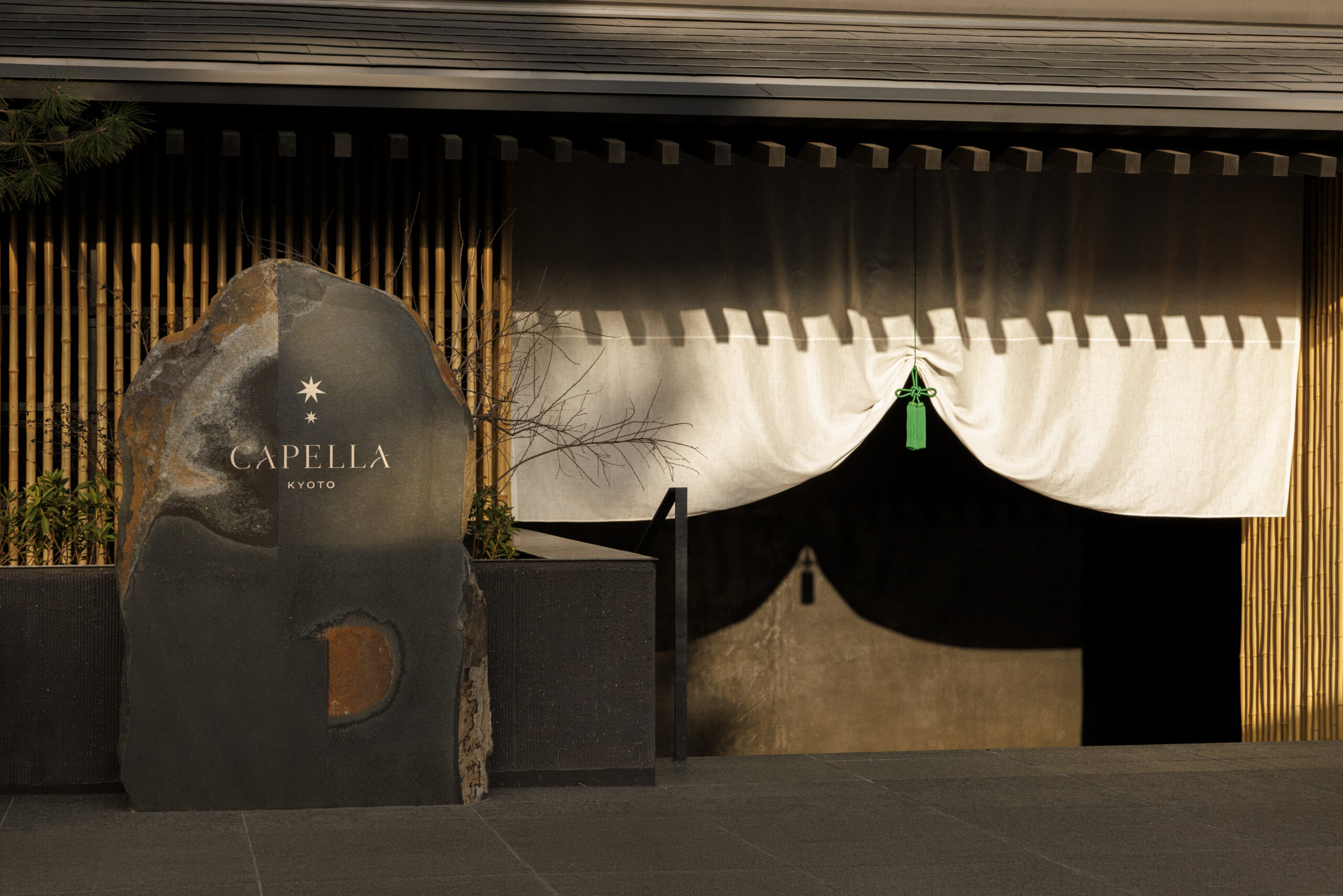
The first thing you notice about the property is what isn’t there. No grandiose entrance, no architectural gymnastics demanding attention. Instead, Kengo Kuma has created a beautifully restrained interpretation of the traditional Kyoto machiya, the narrow wooden townhouses that have shaped the city for generations.
Built on the former site of an elementary school, the hotel unfolds through narrow passageways, hidden gardens and carefully framed views. Singapore-based Brewin Design Office has carried that architectural language indoors, combining warm timber, Japanese materials and beautifully controlled lighting.

The result is less a conventional luxury hotel than a contemporary interpretation of a private Kyoto residence.
There are 89 rooms and suites, including 29 suites, giving the property an intimate feel. Six suites feature private onsen baths, an especially appealing proposition in a city where bathing is part of the culture.
The magic is in the details
My Temple Suite was one of those rooms that makes you reconsider your usual hotel-room routine. The view looked directly toward the rooftops of Kennin-ji, and there was something rather lovely about waking up to a temple rather than a television.

Even the room key had personality. Carved from sandalwood, it released the faintest fragrance each time I picked it up. A small detail, certainly, but the sort that stays with you.
The bathroom was another surprise: speckled granite, warm walnut and lighting designed for a little theater. Inside a drawer, individual toiletries boxes fitted together to reveal an antique-style portrait of a geiko in a blossom-covered kimono. Part packaging, part artwork, and entirely unnecessary in the best possible way. Naturally, I spent far too long looking at it.

Upstairs, the pajamas were made with birch thread and so extraordinarily soft that I briefly considered taking them home. I’ve stayed in some of the world’s finest hotels, and Capella has raised the bar in the sleepwear department.
A little culture with your cocktail
One afternoon, I wandered down to the lobby for a drink and found myself in the middle of a private performance by a geiko. The room fell quiet, the shamisen began, and suddenly the outside world seemed very far away.
There is something extraordinary about encountering a living cultural tradition without the usual sense of spectacle. It was a reminder that Kyoto’s greatest luxury is not something a hotel can manufacture. It is something the city has spent centuries cultivating.

I had come downstairs for a cocktail. I left feeling rather more educated.
The bar, meanwhile, is where Capella allows itself a little personality. Set within the bones of the former schoolhouse, with reclaimed timber overhead and city pop playing in the background, it feels effortlessly cosmopolitan.

The cocktail menu is arranged in five chapters, each with its own character. My favorite was a spectacular foam-topped coupe glowing an almost electric aqua. The gentleman behind the bar, impeccably dressed in a pinstripe suit, delivered it with the calm assurance of someone who knows precisely what he’s doing.
Elsewhere, there is rye washed in brown butter with miso caramel, Kyoto gin mixed with yuzu sake and egg white, and a melon cream soda with a rather grown-up secret. The zero-proof creations, from beetroot and hibiscus to white peach and guava, are equally considered. The Japanese whisky collection is extensive, while the Kyoto sake selection deserves an evening of its own.
My advice? Cancel whatever you had planned.

For all its architectural ambition and cultural credentials, Capella understands an important principle of luxury hospitality: sometimes you simply want something delicious and familiar.
The katsu sando is non-negotiable. The gyudon is equally satisfying, particularly after a long day exploring Kyoto. Breakfast is another reason not to rush, with fresh juices, health shots, beautifully prepared dishes and pastries dangerously easy to justify having twice.
Kyoto, just beyond the doorstep

Eventually, of course, you have to leave the hotel. Fortunately, the neighborhood is rather compelling.
Miyagawa-cho is one of Kyoto’s historic hanamachi, or flower towns, where the traditions of geiko and maiko remain very much alive. The nearby Kaburenjo Theatre hosts performances celebrating the district’s distinctive arts and culture, while the Kamo River, a short walk away, is closely connected with the origins of kabuki. Around you are traditional teahouses, tiny restaurants, wooden facades and the unmistakable click of geta against stone.
This is a neighborhood best explored on foot, preferably without an ambitious itinerary. Take a wrong turn. Pause for a coffee. Watch the light change across an old wooden doorway. Kyoto has never been a city that rewards rushing. And that, perhaps, is where they get it so right.
The great hotels of the world understand that luxury is not necessarily about giving guests more. It is about knowing what to leave out. Here, there is no need to compete with the city or dress up its history. The hotel simply positions itself within the fabric of the neighborhood.

I’ve checked into hotels with bigger suites, grander entrances and considerably more elaborate chandeliers. But there are very few places where I’ve felt quite so reluctant to leave the room, the bar or, for that matter, the neighborhood.
Capella Kyoto may be one of the year’s most compelling new hotel openings, but its greatest achievement is something far less tangible: it makes you feel, if only for a few days, that Kyoto has let you in on a secret.

Some secrets, naturally, are worth traveling halfway around the world for.