Centella. Cica. Madecassoside. Korean skincare labels use all three, sometimes on products sitting beside one another on the same shelf. They are related, but they are not the same thing. Here is how to decode one of K-beauty’s most ubiquitous ingredient families, what the science actually supports, and what to look for before you buy.
By Catalina Tapia
Walk through a beauty store in Seoul and it does not take long to find beauty products containing cica.
Cica creams. Centella ampoules. Madecassoside serums. Barrier creams covered in green leaves. Products promising to calm, soothe, repair and rescue stressed skin.
The terminology makes it sound as though we are dealing with several different skincare discoveries. We are not.
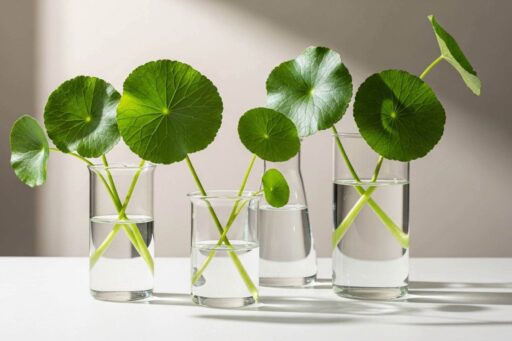
Centella asiatica is a plant. Madecassoside is one of the biologically active compounds found within it. And cica? That is where beauty language becomes considerably less precise. So let us untangle it.
What Exactly Is Centella Asiatica?
Centella asiatica is a herb that grows in tropical and subtropical regions and has a long history of use in traditional Asian medicine. You may also know it as gotu kola. Researchers studying the plant have identified a group of compounds called pentacyclic triterpenes as particularly interesting. Among the best known are Asiaticoside, Madecassoside, Asiatic acid and Madecassic acid.
These compounds have been investigated for effects associated with inflammation, antioxidant activity, collagen-related processes and wound healing.[1][2]
That does not mean a Centella moisturiser is a medicine or that putting it on healthy skin will reproduce results seen in wound-healing research. It does mean there is considerably more science behind the plant than its current K-beauty popularity might suggest.
Then What Is Cica?
This is the term most likely to confuse shoppers. In contemporary skincare, cica generally refers to products formulated around Centella asiatica or its derivatives.
It is useful shorthand. It is not, however, the name of one specific cosmetic ingredient.
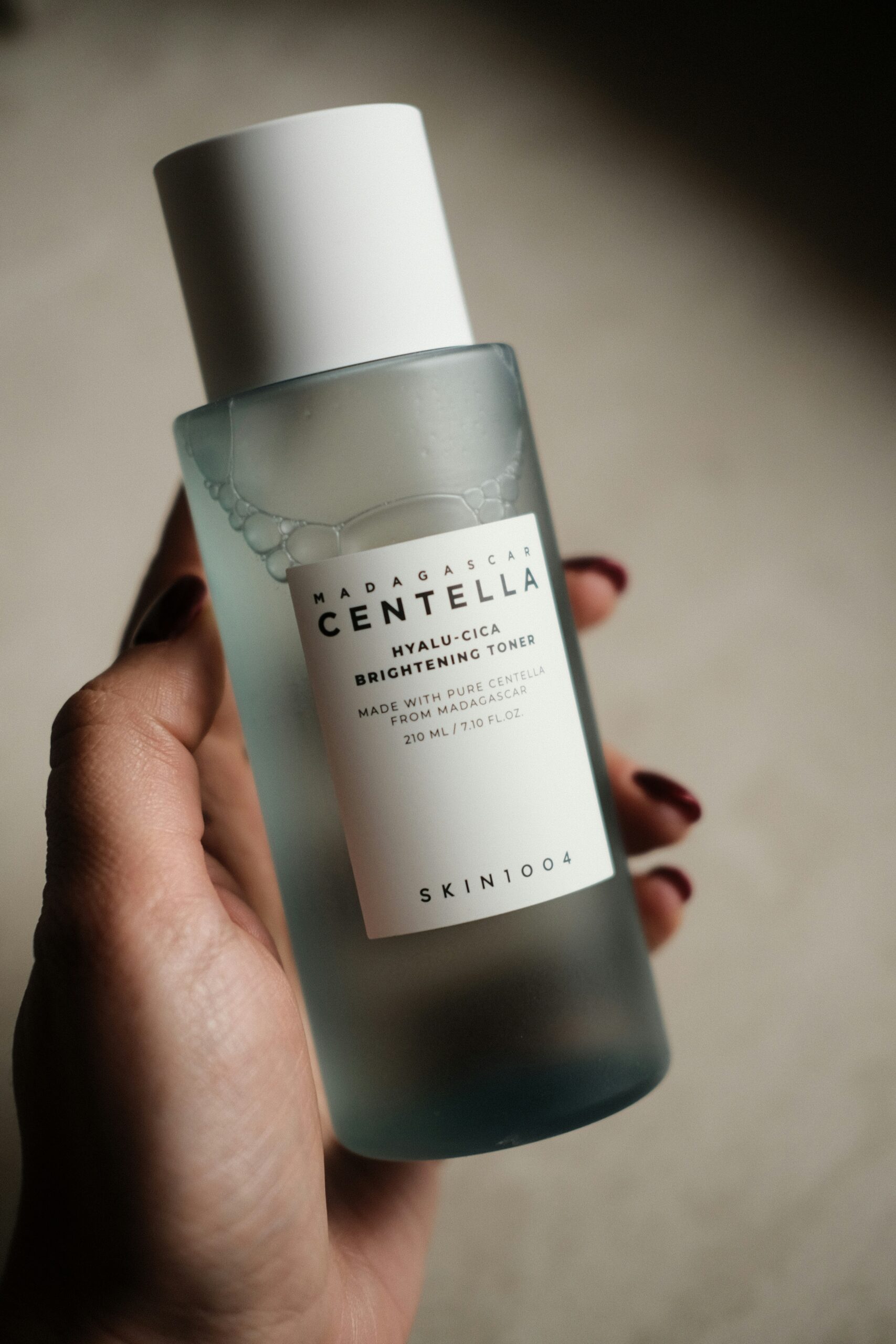
A bottle labelled “cica cream” might contain Centella asiatica extract. Another might highlight madecassoside. Another could contain several Centella-derived compounds alongside ceramides, panthenol, glycerin or other ingredients. So when you see CICA printed prominently across the front of a bottle, turn it around. The ingredient list tells you far more than the word cica does.
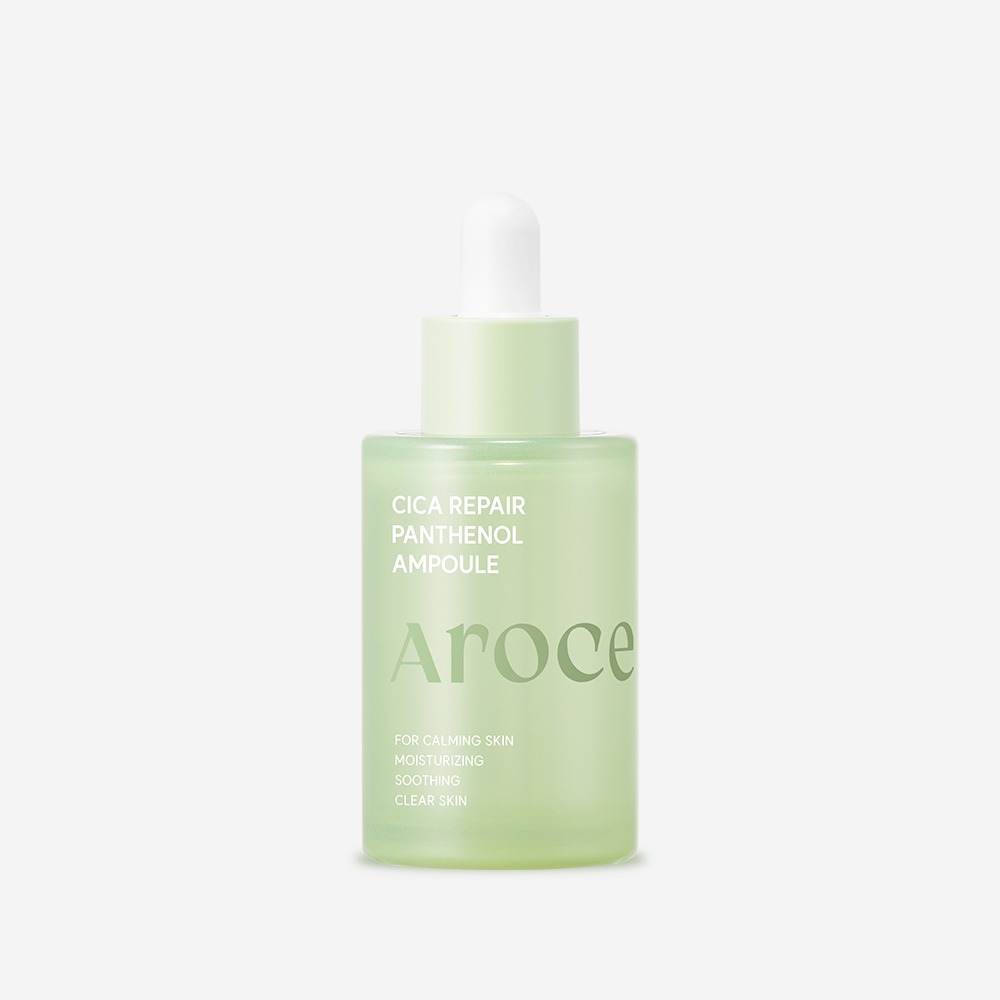
And Madecassoside?
Now we are getting more specific. Madecassoside is one of the principal triterpenoid compounds associated with Centella asiatica.[2]
Think of it this way:
Centella asiatica = the plant
Centella extract = an extract containing a mixture of compounds from the plant
Madecassoside = one specific compound associated with the plant
Cica = the broad skincare language commonly used around Centella-based products
That is the distinction worth remembering.
So, What Can Centella Actually Do for Your Skin?
This is where we need to separate plausible benefits from the extraordinary list of claims that can accumulate around a fashionable botanical.
Calming irritated skin
Centella has been studied for its anti-inflammatory properties, and there is research suggesting that formulas containing the plant may help calm irritation while improving hydration.[1][3][4] In practical terms, that makes it an interesting ingredient to look for when your skin feels dry, uncomfortable or irritated, particularly if your routine has become a little too enthusiastic with actives. But think calming skincare, not treatment. Centella is not a substitute for medical care if you are dealing with an inflammatory skin condition.
Hydration and barrier support
Studies have found improvements in hydration and measures associated with the skin barrier when Centella-containing creams were used regularly.[4][5] But here is the part the front of the bottle will not tell you: Centella may not be doing all the work. A good cica cream might also contain glycerin, ceramides, emollients and other ingredients that help keep water in the skin and support the barrier. So rather than searching for the highest possible percentage of Centella, look at the formula as a whole. The best barrier cream is not necessarily the one shouting CICA the loudest.
Wound healing
TLong before cica became a K-beauty buzzword, Centella was being studied for wound healing. Reviews of the research suggest that the plant and some of its compounds may play a role in processes involved in skin repair, although the clinical evidence is still limited.[1][6] Centella has even been studied after procedures such as facial laser resurfacing, with research suggesting potential benefits during recovery.[7] That helps explain why the ingredient has developed such a strong association with “repair”.
But there is an important distinction. Evidence that Centella may support wounded or post-procedure skin does not prove that an everyday cica serum can “repair” healthy skin. Those are different claims.
A Simple Centella Guide by Life Stage
Age should not determine whether you need Centella. Unlike retinoids, this is not an ingredient family that becomes inherently more relevant simply because skin is older.
Think of this table as shopping guidance rather than a prescription.
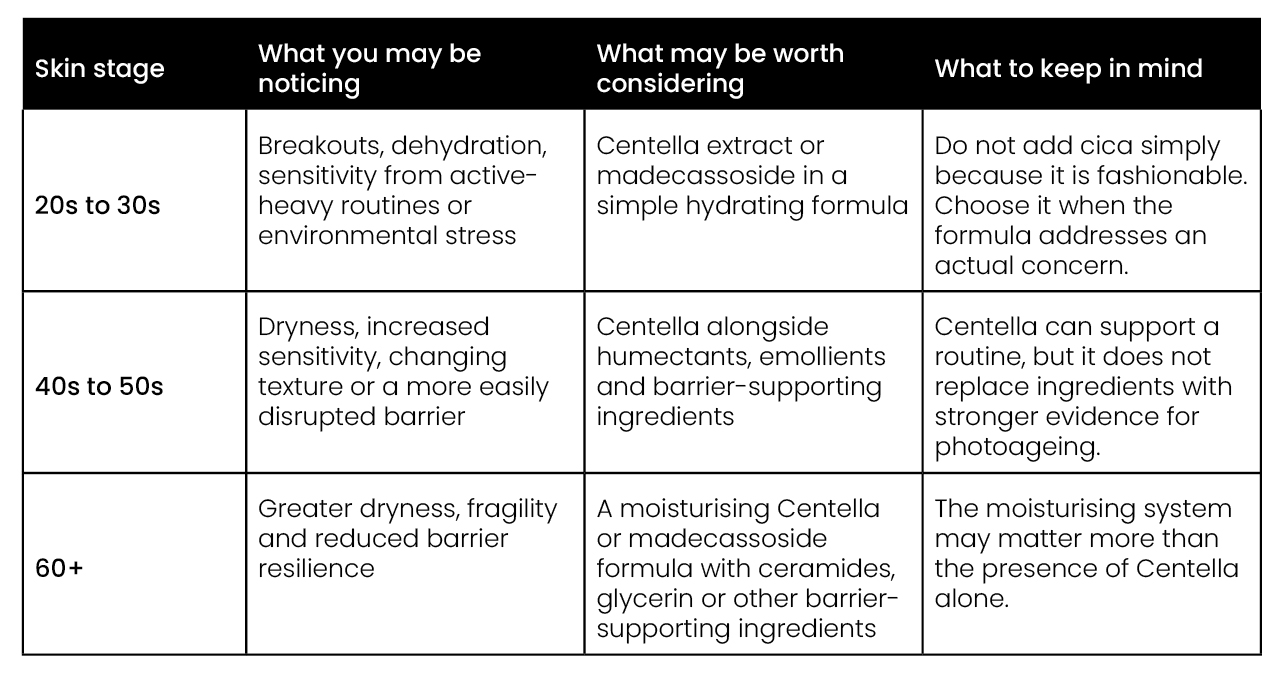
Remember: skin condition matters more than age. A 24-year-old using several irritating actives may have more reason to consider a calming moisturiser than a 64-year-old whose existing routine is working perfectly well.
The Raven Centella Cheat Sheet
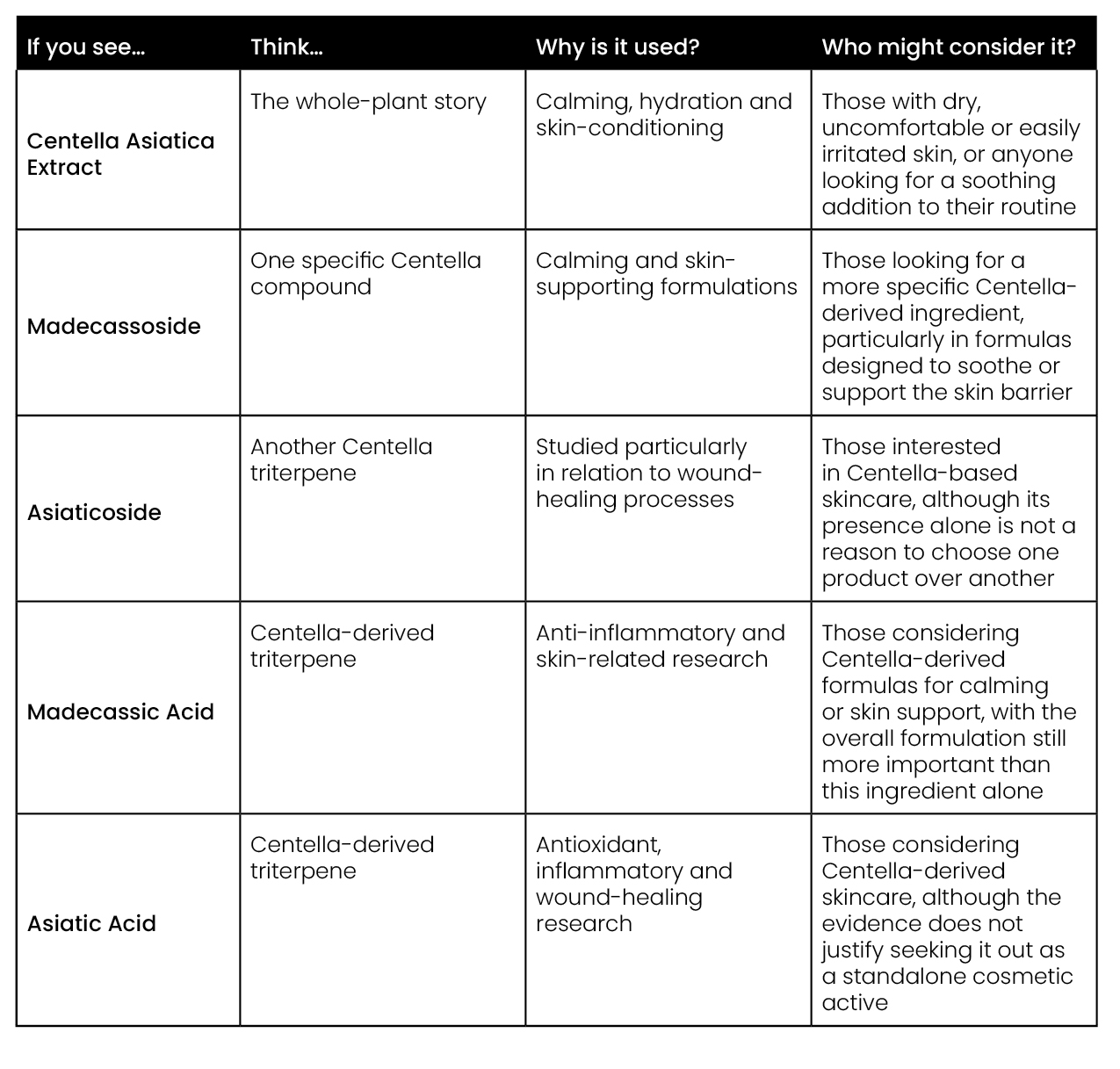
You do not need to memorise all five compounds.
For beauty shopping, the two names most worth recognising are Centella asiatica and madecassoside.
And when you see “cica”, investigate further.
Centella Extract
Think: the broader botanical.
Centella extract contains multiple constituents rather than one isolated active compound. Exactly what is present can depend on the plant material, extraction method and standardisation. This is one reason “80% Centella” on the front of a bottle is less informative than it sounds. Percentage alone does not tell you the concentration of the compounds you actually care about. Nor does it tell you whether 80% of one Centella preparation is superior to 10% of another.
Madecassoside
Think: the more specific option.
Madecassoside has been studied for anti-inflammatory, antioxidant and wound-healing-related activity.[2] There is also human research, although it requires careful interpretation. One randomised double-blind study of 20 women examined a formula containing 0.1% madecassoside plus 5% vitamin C over six months. Researchers reported improvements in wrinkles, firmness, roughness, hydration and measures of skin elasticity.[8]
Interesting? Yes.
Proof that madecassoside alone produces those effects? No.
Because the formula also contained vitamin C, the results cannot simply be attributed to madecassoside. This is precisely why ingredient research needs context.
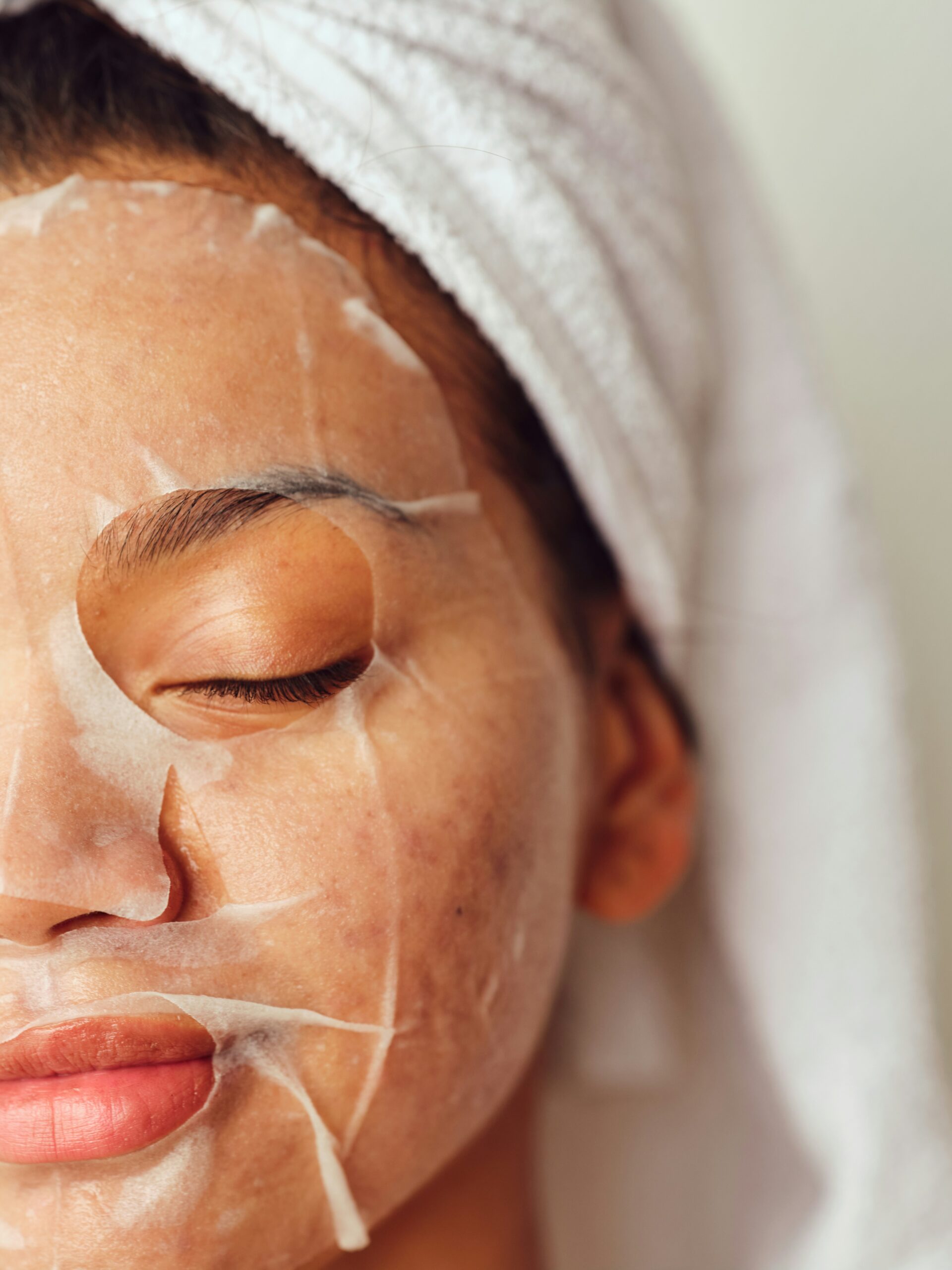
Is Centella Good for Sensitive Skin?
Potentially, but “sensitive-skin ingredient” should never be interpreted as “incapable of causing a reaction”.
Centella is generally used in products intended to soothe skin, and a cosmetic safety assessment concluded that nine Centella-derived cosmetic ingredients were safe under their reported conditions of use when formulated to be non-sensitising.[9] However, allergic contact dermatitis to Centella has been documented in the medical literature.[10] That appears uncommon, but it matters.
Botanical does not mean hypoallergenic.
And if your cica cream also contains fragrance, essential oils or several other botanical extracts, Centella may not be the ingredient determining whether your skin tolerates the product.
Is Madecassoside Better Than Centella?
Wrong question.
Madecassoside is more chemically specific. Centella extract contains a broader mixture of plant constituents. Neither fact automatically makes one better. If you want a straightforward calming moisturiser, a well-formulated Centella product may be entirely sensible. If a brand is specifically promoting madecassoside and can tell you how much it contains, why that concentration was selected and whether the finished product has been tested, that gives you more useful information.
The formula wins.
The Raven Shopping Test
1. What is actually in it?
“Cica” is not enough. Look for Centella asiatica extract, madecassoside or another clearly identified derivative.
2. What am I buying it to do?
Calm uncomfortable skin? Support hydration? Complement a barrier-focused routine? Start with the concern.
3. Is the percentage meaningful?
A huge Centella percentage makes an excellent number for the front of a bottle. It does not automatically tell you how much madecassoside, asiaticoside or other active constituent is present.
4. What else is in the formula?
For dry or barrier-compromised skin, ingredients such as glycerin, ceramides and emollients may be just as important, or more important, than Centella itself.
5. Has the finished product been tested?
Evidence behind Centella is useful. Evidence behind the exact cream or serum you are buying is more useful.
If You Remember Nothing Else
Centella asiatica: the plant.
Cica: skincare shorthand, not one precise ingredient.
Madecassoside: one of Centella’s principal bioactive compounds.
Asiaticoside, asiatic acid and madecassic acid: other names you may encounter within the Centella family.
Centella has interesting evidence around inflammation, hydration and wound healing. Wound-healing research does not automatically prove that a cosmetic “repairs” healthy skin. A higher Centella percentage does not automatically mean a better product. And botanical does not mean irritation-proof.
What Does the Science Actually Say?
Centella deserves more serious consideration than the word “cica” on a pastel-green jar might suggest. There is laboratory, animal and human research examining Centella asiatica and its triterpenes, particularly in wound healing and inflammatory processes.[1][2][3] There is also smaller-scale human research supporting hydration and barrier-related effects.[4][5] But the evidence is uneven. Different studies use whole Centella extracts, standardised extracts, isolated compounds or multi-ingredient formulas. Some investigate healthy skin, others wounds, burns or post-procedure recovery. Those results should not be bundled together and treated as proof of every claim made for a cosmetic cica cream. The science is promising enough to take Centella seriously. It is not a licence to stop reading the rest of the ingredient list.
The Raven Verdict
Centella may have become synonymous with K-beauty’s soothing green creams, but it is considerably older and more scientifically interesting than the trend surrounding it. The most important thing to understand is the language.
Centella is the plant. Madecassoside is one of its important compounds. Cica is the umbrella term beauty has adopted around them.
For dry, uncomfortable or easily irritated skin, a thoughtfully formulated Centella product can make sense. Madecassoside is particularly worth recognising when reading ingredient lists. But do not buy a product simply because “cica” is written across the bottle. Turn it around. Find out which Centella ingredient is actually there. Look at the rest of the formula. Decide what you want it to do. Then ask whether the evidence and formulation justify the promise and the price.
Because once you understand what cica actually means, shopping for it becomes considerably less complicated.
THE INGREDIENT EDIT
Next: Mugwort, Heartleaf and Rice: Do K-Beauty’s Botanical Ingredients Deserve the Attention?
References
- Arribas-López E, Zand N, Ojo O, Snowden MJ, Kochhar T. Topical Application of Centella asiatica in Wound Healing: Recent Insights into Mechanisms and Clinical Efficacy. Pharmaceutics. 2024;16(10):1252. doi:10.3390/pharmaceutics16101252.
- Sun B, Wu L, Wu Y, et al. Therapeutic properties and pharmacological activities of asiaticoside and madecassoside: A review. Journal of Cellular and Molecular Medicine. 2023;27(5):593-608. doi:10.1111/jcmm.17635.
- Park KS. Pharmacological Effects of Centella asiatica on Skin Diseases: Evidence and Possible Mechanisms. Evidence-Based Complementary and Alternative Medicine. 2021;2021:5462633. doi:10.1155/2021/5462633.
- Ratz-Łyko A, Arct J, Pytkowska K. Moisturizing and Antiinflammatory Properties of Cosmetic Formulations Containing Centella asiatica Extract. Indian Journal of Pharmaceutical Sciences. 2016;78(1):27-33. doi:10.4103/0250-474X.180247.
- Anggraeni S, Umborowati MA, Damayanti D, Endaryanto A, Prakoeswa CRS. Role of Centella asiatica and ceramide in skin barrier improvement: a double blind clinical trial of Indonesian batik workers. Journal of Basic and Clinical Physiology and Pharmacology. 2021;32(4):589-593. doi:10.1515/jbcpp-2020-0510.
- A Systematic Review of the Effect of Centella asiatica on Wound Healing. International Journal of Environmental Research and Public Health. 2022;19(6):3266. doi:10.3390/ijerph19063266.
- Damkerngsuntorn W, Rerknimitr P, Panchaprateep R, et al. The Effects of a Standardized Extract of Centella asiatica on Postlaser Resurfacing Wound Healing on the Face: A Split-Face, Double-Blind, Randomized, Placebo-Controlled Trial. Journal of Alternative and Complementary Medicine. 2020;26(6):529-536. doi:10.1089/acm.2019.0325.
- Haftek M, Mac-Mary S, Le Bitoux MA, et al. Clinical, biometric and structural evaluation of the long-term effects of a topical treatment with ascorbic acid and madecassoside in photoaged human skin. Experimental Dermatology.2008;17(11):946-952. doi:10.1111/j.1600-0625.2008.00732.x.
- Johnson W Jr, Bergfeld WF, Belsito DV, et al. Safety Assessment of Centella asiatica-Derived Ingredients as Used in Cosmetics. International Journal of Toxicology. 2023;42(1 Suppl):5S-22S. doi:10.1177/10915818231158272.
- Gomes J, Pereira T, Vilarinho C, Duarte ML, Brito C. Contact dermatitis due to Centella asiatica. Contact Dermatitis. 2010;62(1):54-55. doi:10.1111/j.1600-0536.2009.01651.x.