
Retinol. Retinal. Retinoic acid. Retinoids. The beauty industry often uses the terms as though they are interchangeable. They are not. Here is what the vitamin A family actually does for your skin, how the different forms compare, and what you need to know before choosing one.
By Catalina Tapia
Walk into almost any beauty store looking for a vitamin A product and the first problem is not finding one. It is working out what you are actually buying.
There are retinol serums. Retinal creams. Retinyl palmitate. Prescription tretinoin. Products described simply as “retinoids”. And an expanding collection of newer vitamin A derivatives. They all belong to the same broad vitamin A family. They are not, however, the same ingredient. This matters because different retinoids vary in what they are used for, how much research sits behind them and how likely they are to irritate your skin.
So let us untangle it.
First: What Exactly Is a Retinoid?
Retinoid is the family name.
Retinol is a retinoid. Retinal is a retinoid. Tretinoin is a retinoid. But retinoid does not mean retinol.
Think of wine and Champagne. Champagne belongs to the broader category of wine, but not every wine is Champagne. Much as we might wish otherwise.
The other useful thing to understand is that some forms of vitamin A have to go through a series of steps in the skin before becoming retinoic acid, the biologically active form responsible for many of the effects associated with retinoids.
Retinyl esters → Retinol → Retinal → Retinoic acid
You do not need to memorise the pathway. Just remember that different members of the family take different routes to get to work, and fewer conversion steps do not automatically mean a better product.
So, What Do Retinoids Actually Do for Your Skin?
Before we get into retinol versus retinal, there is a more useful question, Why use one at all?
Fine lines and wrinkles: Some retinoids can support processes involved in collagen production and improve the appearance of aged and photoaged skin.
Texture: Retinoids influence epidermal cell proliferation and differentiation, which can contribute to smoother, more even-looking skin over time.
Uneven tone and sun damage: Certain retinoids can improve visible signs of accumulated sun exposure, including mottled pigmentation.
Acne and clogged pores: Topical retinoid medicines can help normalise follicular keratinisation and prevent pores from becoming blocked, which is why retinoids are widely used in acne treatment.
Firmness: Through their effects on collagen and other structures within photoaged skin, some retinoids may improve the appearance of firmness over time.
The important word here is some.
Not every retinoid does these things equally well, and not every member of the vitamin A family has the same amount or quality of evidence behind it.
Maria Enna-Cocciolone, Founder and CEO of INSKIN COSMEDICS, has worked in the professional beauty industry for four decades. She describes retinoids through a musical analogy.
“For me they are like conductors of an orchestra. The conductor acts as the primary communicator, responsible for harmonic balance and synchronisation, and that’s exactly the role of retinoids in the skin and in an effective skin solution, they fine tune a complex system to ensure it all runs in perfect harmony.”
It is an analogy rather than a scientific definition, but a useful one. Retinoids do not simply “exfoliate” the skin, as they are sometimes described online. Their biological effects are considerably more complex.
A Simple Retinoid Guide by Life Stage
Age should never dictate your skincare routine, but skin does change throughout life. Think of this as a shopping guide rather than a prescription.
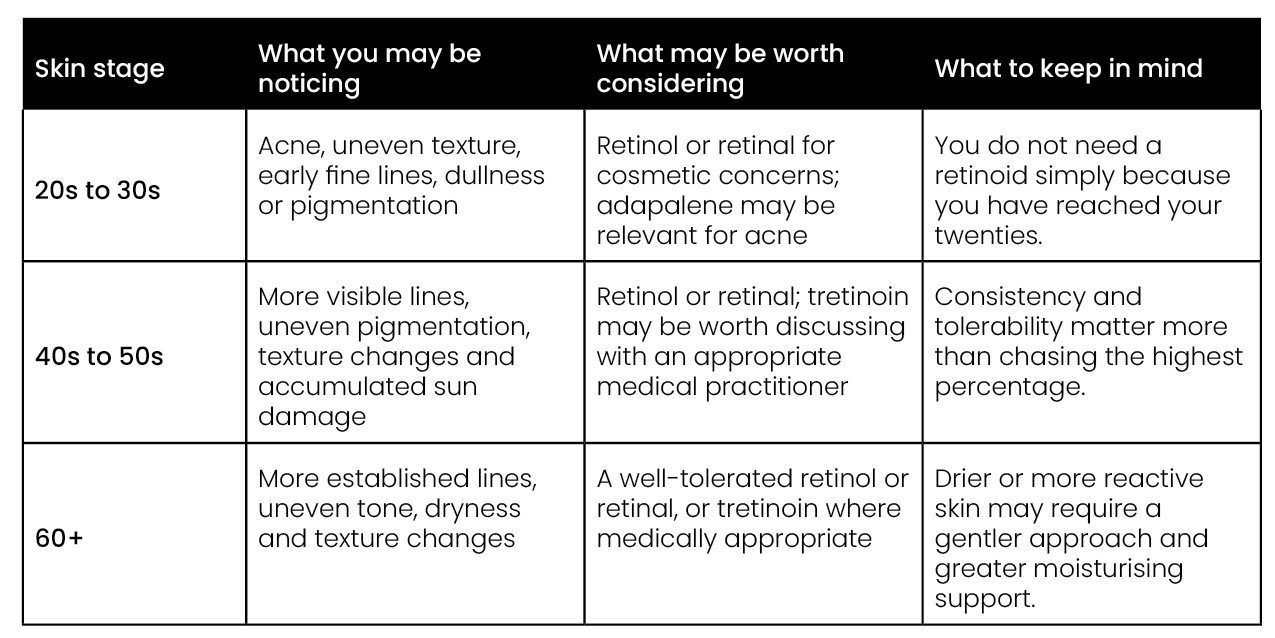
Remember: your skin does not suddenly require a stronger retinoid because you have entered a new decade.
Sun exposure, genetics, hormones, skin condition, existing concerns and individual tolerance matter considerably more than the number on your passport.
The Raven Retinoid Cheat Sheet
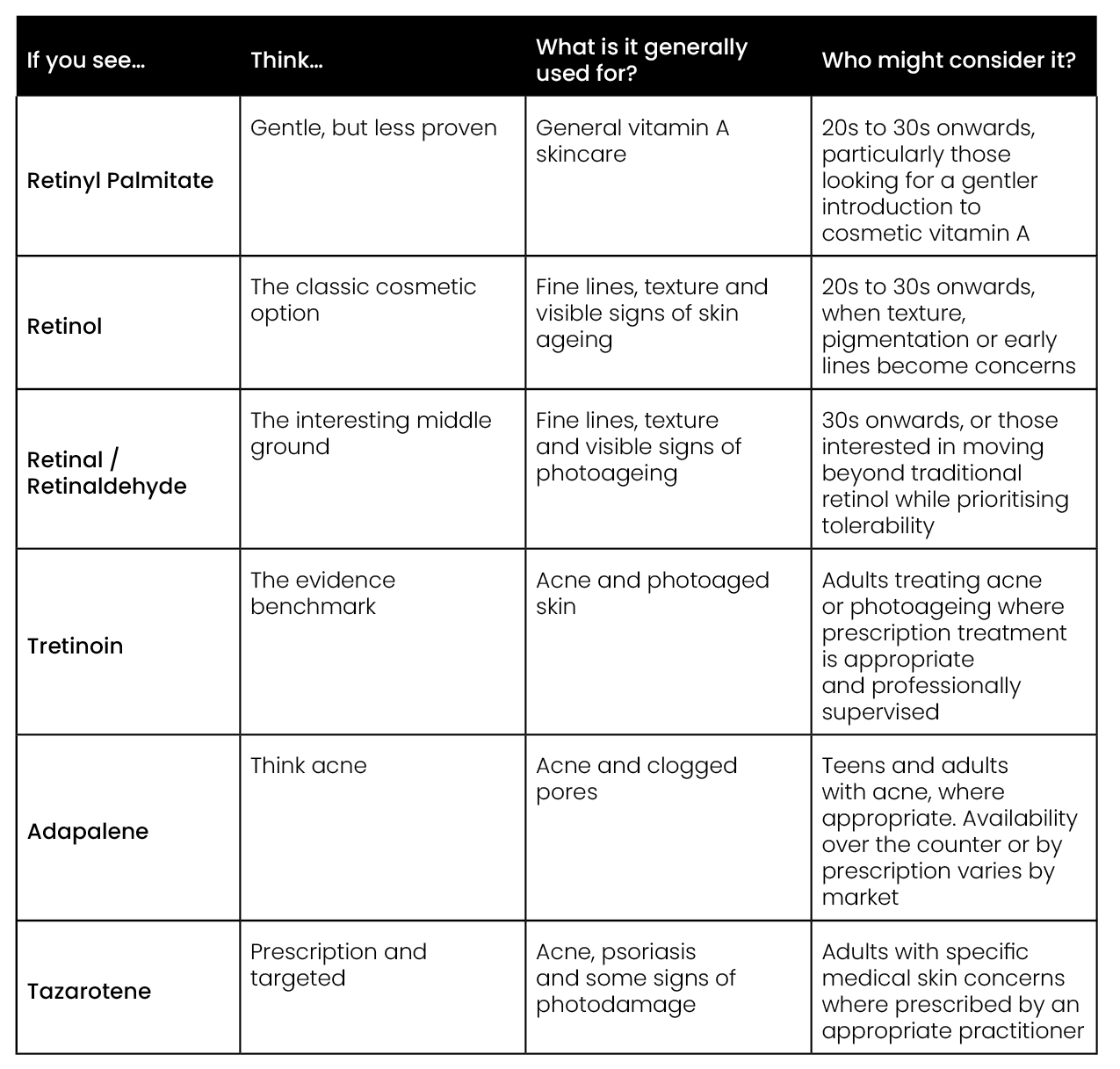
You do not need a bathroom cabinet containing all six.
For most cosmetic skincare shoppers, the main names worth understanding are retinol and retinal. Tretinoin becomes relevant when you enter the prescription conversation.
Retinyl Palmitate
Think: gentle, but less proven.
Retinyl palmitate is one of the gentler forms of vitamin A you are likely to find in skincare, often appearing in moisturisers and formulas designed as a softer introduction to retinoids. The trade-off? The evidence behind it is considerably more limited than for better-studied retinoids.[1]
That does not mean a product containing retinyl palmitate cannot be worthwhile. It simply means gentler should not automatically be translated as equally effective.
Retinol
Think: the classic cosmetic retinoid.
Retinol is probably the name you already recognise. It is widely available and commonly used to target fine lines, uneven texture and visible signs of skin ageing. And yes, there is research showing that retinol can improve the appearance of aged skin.[2] But there is an important reality check.
When researchers have looked at the evidence behind over-the-counter vitamin A cosmetics as a whole, the results are less impressive and consistent than retinol’s enormous popularity might suggest.[3] In other words, there is evidence behind retinol, but that does not mean every retinol serum works equally well.
And seeing 1% retinol on a bottle does not automatically make it better than a lower concentration. Formulation, stability, delivery and, importantly, whether your skin can actually tolerate it all matter.
Retinal
Think: the interesting middle ground.
Retinal and retinaldehyde are two names for the same ingredient. Remember our vitamin A pathway? Retinal sits one step away from retinoic acid, while retinol sits two. That is one reason retinal has attracted so much attention. Human studies suggest it can improve signs of photoageing and may be reasonably well tolerated.[4][5]
Maria says retinal is personally her preferred cosmetic vitamin A option because of its balance between activity and tolerability.
But this is also where the marketing gets interesting. You may have seen retinal described as “stronger”, “11 times faster” or almost equivalent to prescription retinoic acid. Do not take those comparisons too literally. Being one conversion step closer to retinoic acid makes retinal interesting, but it does not prove that every retinal product will work faster or outperform every retinol product.
The formula still matters.
Tretinoin
Think: the evidence benchmark.
Tretinoin is retinoic acid, so unlike retinol and retinal, it does not need to go through the same conversion process first. More importantly for the consumer, it has decades of clinical research behind it. Tretinoin is well established in the treatment of acne and has strong evidence for improving signs of photoageing, including wrinkles, uneven pigmentation and texture.[6][7]
Again… stronger evidence does not mean easier to use. Tretinoin can cause dryness, redness, peeling and irritation, particularly when you first begin using it. It is also a medicine, and how it is prescribed or supplied varies internationally. So while tretinoin, retinal and retinol all belong to the retinoid family, prescription tretinoin and a cosmetic retinol serum are not interchangeable simply because both contain forms of vitamin A.
Retinol or Retinal: Which Should You Buy?
If you are completely new to cosmetic vitamin A, retinol remains a logical starting point because there is an enormous choice of formulations and concentrations. If you already use retinol comfortably, or are specifically interested in retinal, retinal is worth considering. What you should not do is compare the percentages as though they refer to the same ingredient. A 1% retinol product is not automatically “ten times stronger” than a 0.1% retinal product.
Instead ask:
Which retinoid is it?
What am I trying to address?
What evidence supports it?
Can my skin realistically tolerate the formulation?
Those questions tell you considerably more than the biggest number printed on the bottle.
And What About Adapalene and Tazarotene?
These are synthetic retinoids and do not sit neatly on the retinyl ester → retinol → retinal → retinoic acid pathway.
Adapalene: think acne. It is primarily used to treat acne and clogged pores and is available over the counter in some markets and by prescription in others.
Tazarotene: think targeted prescription treatment. It is used medically for conditions including acne and psoriasis and has also been studied for photodamaged skin.
For the average beauty shopper choosing between cosmetic vitamin A serums, neither needs to become another ingredient to memorise. If acne or another medical skin condition is the reason you are considering a retinoid, however, the conversation becomes different from choosing an over-the-counter cosmetic serum and may warrant professional advice.
Why Do Retinoids Irritate the Skin?
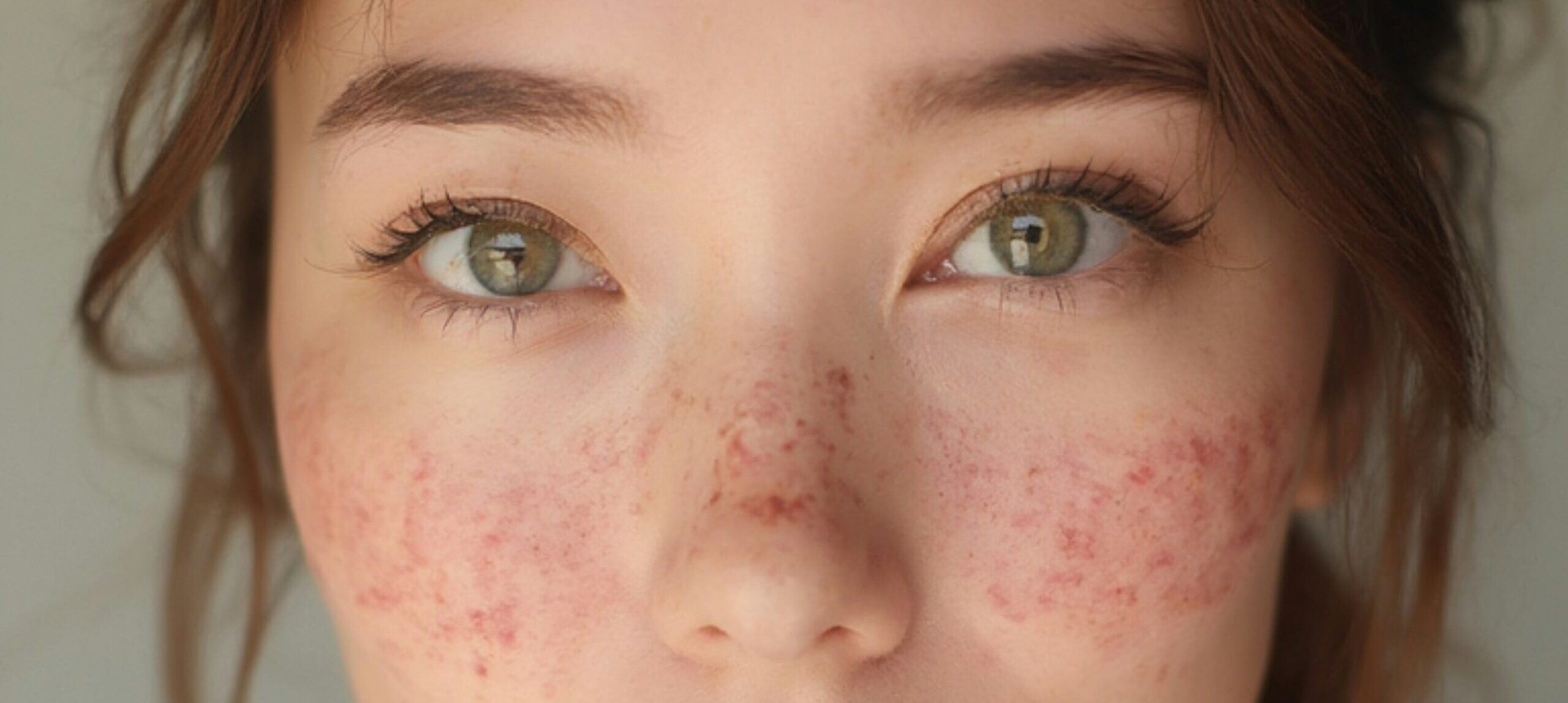
Dryness. Flaking. Redness. Stinging.
These are common problems when people begin using some retinoids, introduce them too quickly or use more than their skin comfortably tolerates. Sometimes this is dismissed online as “retinisation”, or even interpreted as evidence that a product is working.
Irritation is not proof of efficacy. Peeling is not the objective. Skin may become more tolerant to a retinoid over time, but there is no prize for using one seven nights a week.
Starting gradually, using an appropriate moisturiser and keeping the rest of the routine relatively simple can make retinoids easier to tolerate. Three comfortable applications a week may be more useful than nightly use that leaves your skin so irritated that you have to stop altogether.
Maria uses another simple analogy:
“My analogy here is if you hit a brick wall you don’t reverse the car and hit it again. Inflammation is the brick wall and once you hit it, the key is to pull back until the skin normalises and then gently drip feed the active back into your routine.”
Persistent or significant irritation deserves reassessment rather than determination to “push through”.
How Should You Use a Retinoid?
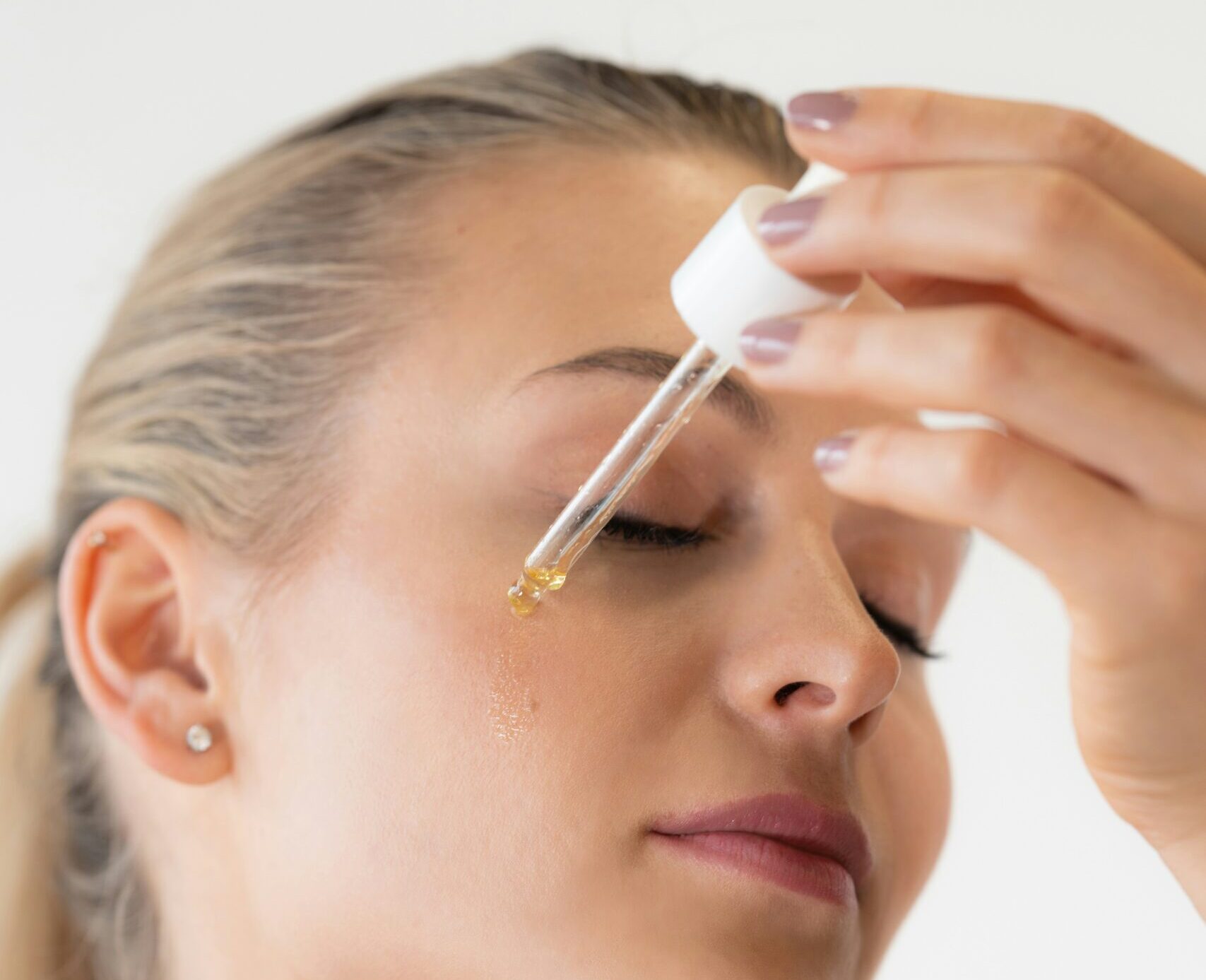
For most people, evening is the simplest default.
If you are using a retinoid because you are concerned about visible sun damage, daily broad-spectrum sun protection is fundamental regardless, sunscreen does matter. Some topical retinoids can also be irritating, making sensible sun protection particularly important.
What about vitamin C and acids?
The internet has produced an exhausting collection of rules about what you can and cannot combine with retinol. The practical issue is often tolerability rather than a universal rule that two ingredients can never coexist. Combining several potentially irritating products may simply be too much for some skin, particularly when first introducing a retinoid. If your routine requires a spreadsheet to remember which active belongs on which night, simplifying it may be more useful.
What About Pregnancy?
This is one area where caution should override experimentation.
Topical retinoid medicines should not be used during pregnancy or when planning pregnancy. The European Medicines Agency notes that systemic absorption from topical retinoids is low, but recommends avoiding them during pregnancy as a precaution.[8] Anyone who is pregnant, planning pregnancy or breastfeeding should seek appropriate advice from their doctor, dermatologist, pharmacist or other qualified healthcare professional about the products they are using. And while ingredients such as bakuchiol are frequently marketed as “retinol alternatives”, that does not make them automatically equivalent to retinoids or establish them as universally pregnancy-safe substitutes.
The Raven Shopping Test
1. Which retinoid is actually in it?
“Vitamin A complex” tells you very little. Retinol? Retinal? Retinyl palmitate? Turn the bottle around.
2. What am I buying it to do?
Acne? Fine lines? Texture? Pigmentation? Start with the concern rather than the strongest-sounding ingredient.
3. Am I being distracted by the percentage?
A bigger does not automatically mean a better, particularly when comparing different retinoids. Do not compare 1% retinol with 0.1% retinal as though you are comparing two concentrations of the same ingredient.
4. Has the actual product been tested?
Evidence behind an ingredient is useful. Evidence showing that the finished serum or cream you are buying performs as promised is better. Pay attention to whether the study investigated the ingredient itself, a prototype formulation or the finished product sitting in front of you.
5. Can I realistically use it?
This may be the most important question of all. A theoretically powerful formula that leaves your skin constantly irritated is not a clever investment. Consistency matters.
If You Remember Nothing Else
Retinoid: the family name.
Retinyl palmitate: gentle, but less well proven.
Retinol: the familiar cosmetic all-rounder.
Retinal: one step closer to retinoic acid and increasingly interesting.
Tretinoin: the prescription evidence benchmark.
Adapalene: think acne.
Tazarotene: think targeted medical treatment.
Bigger (%) does not automatically mean better. One fewer conversion step does not automatically mean a better finished product. Irritation does not mean it is working harder.
Consistency matters. Sunscreen matters.
What Does the Science Actually Say?
There is a good reason retinoids have survived decades of changing skincare trends. But the evidence is not equally strong for every member of the family.
Tretinoin has the strongest clinical history, particularly for photoaged skin.[6][7]
Retinol has human research behind it, including evidence of effects on fine wrinkling and skin matrix markers, but systematic assessment of over-the-counter cosmetic retinol products has found the clinical evidence much more variable than the category’s popularity might suggest.[2][3]
Retinal has encouraging human clinical research and may offer an interesting balance between cosmetic activity and tolerability, but the evidence base is considerably smaller than that supporting tretinoin.[4][5]
Retinyl esters sit further down the evidence hierarchy for visible photoageing.[1]
And across all of them, research on an ingredient does not automatically prove that every finished product containing it will deliver the same result.
So the useful question is not simply Do retinoids work?
It is Which retinoid are we talking about, in what formulation, at what concentration, for which concern, and supported by what evidence?
The Raven Verdict
Retinoids deserve their reputation more than most fashionable skincare ingredients. But that does not mean every bottle carrying the word retinol, retinal or vitamin A deserves yours. If you are new to cosmetic vitamin A, retinol remains a logical place to begin. If you want to explore beyond traditional retinol, retinal is particularly worth understanding. If acne is your primary concern, medical retinoids such as adapalene may become more relevant. And if prescription treatment is appropriate, tretinoin occupies a different evidence category from cosmetic vitamin A.
Turn the product around. Find the actual retinoid. Work out what you want it to do. Look at the evidence. And ask whether your skin can realistically tolerate it.
Maria’s practical advice comes back to consistency. Retinol and retinal ultimately rely on conversion to retinoic acid within the skin, but the route, formulation and evidence surrounding them differ. The useful product is not necessarily the one that sounds strongest. It is the one appropriate to your skin and concerns that you can use consistently without repeatedly provoking irritation.
The goal is not to find the strongest retinoid your skin can survive. It is to find the right one for the concern you actually want to address.
Because the smartest question is not: How strong is it?
It is: What am I actually buying, and what can it realistically do for my skin?
The Expert: Maria Enna-Cocciolone
Maria Enna-Cocciolone is the Founder and CEO of INSKIN COSMEDICS, the Australian professional beauty company she established in 2007. With 40 years of experience in the professional beauty industry, her career has spanned aesthetics, sales, education, management, business ownership and skincare brand development.
Through INSKIN COSMEDICS, Maria has created three professional skincare brands: O COSMEDICS, GINGER&ME and INSKIN.CO. She is also a Board member of the Aesthetic Beauty Industry Council, and remains closely involved in the development and direction of the INSKIN COSMEDICS portfolio as the company expands internationally.
Her philosophy is that the brands within her portfolio should make both “good business and good skin sense”, with an emphasis on professional education, considered formulation and supporting skin professionals and their clients.
Expert Disclosure: Maria’s comments in this article reflect her professional beauty-industry perspective. Independent scientific literature remains the basis for The Raven Reports’ assessment of peptide efficacy.
Explore O COSMEDICS or follow O COSMEDICS on Instagram.
THE INGREDIENT EDIT
Next: Centella, Cica and Madecassoside: What’s the Difference?
References
- Green C, Orchard G, Cerio R, Hawk JLM. A clinicopathological study of the effects of topical retinyl propionate cream in skin photoageing. Clinical and Experimental Dermatology. 1998;23(4):162-167. doi:10.1046/j.1365-2230.1998.00331.x.
- Kafi R, Kwak HSR, Schumacher WE, et al. Improvement of naturally aged skin with vitamin A (retinol). Archives of Dermatology. 2007;143(5):606-612. doi:10.1001/archderm.143.5.606.
- Spierings NMK. Evidence for the efficacy of over-the-counter vitamin A cosmetic products in the improvement of facial skin aging: A systematic review. Journal of Clinical and Aesthetic Dermatology.2021;14(9):33-40. PMID: 34980969.
- Creidi P, Vienne MP, Ochonisky S, et al. Profilometric evaluation of photodamage after topical retinaldehyde and retinoic acid treatment. Journal of the American Academy of Dermatology.1998;39(6):960-965. doi:10.1016/S0190-9622(98)70270-1.
- Kwon HS, Lee JH, Kim GM, Bae JM. Efficacy and safety of retinaldehyde 0.1% and 0.05% creams used to treat photoaged skin: A randomized double-blind controlled trial. Journal of Cosmetic Dermatology.2018;17(3):471-476. doi:10.1111/jocd.12551.
- Sitohang IBS, Makes WI, Sandora N, Suryanegara J. Topical tretinoin for treating photoaging: A systematic review of randomized controlled trials. International Journal of Women’s Dermatology.2022;8(1):e003. doi:10.1097/JW9.0000000000000003.
- Siddiqui Z, et al. Comparing tretinoin to other topical therapies in the treatment of skin photoaging: A systematic review. American Journal of Clinical Dermatology. 2024;25(6):873-890. doi:10.1007/s40257-024-00893-w.
- European Medicines Agency. Updated measures for pregnancy prevention during retinoid use. European Medicines Agency. 2018.


This is such valuable and insightful information! I’ve always stayed away from Retinol because I found it confusing and intimidating.
This article lays it all out perfectly.